COURSE READING AND WORKSHEETS
How to choose a marketing channel for your SaaS
Choose a marketing channel by working backward from the customers you need, the way they buy, and the resources you can sustain. Then define a specific acquisition approach and a limited test. “We're going to do LinkedIn” is too vague to evaluate.
You want a plan closer to this: “We'll use examples of broken analytics workflows to start conversations with data leads at small SaaS companies, then offer a review of one report.” Now you can judge whether the audience is reachable, whether the offer is useful, and whether you can do the work.
The goal of this guide is a one-page acquisition brief. You don't need a strategy deck or a presence on every platform.
Start with the customer and the buying situation
Describe someone who has a reason to act. Include their role, the problem, the current workaround, and what makes the problem matter now.
“Developers” gives you little direction. “Platform engineers whose teams are spending hours investigating failed API calls” tells you what to research and what a useful conversation could address.
Separate the user from the buyer when necessary. A developer may evaluate your tool, while a manager approves spending and security reviews the integration. Your approach needs to help the product move through that process.
Next, ask where these people look when the problem becomes important:
- Do they search for a solution or a specific error?
- Do they ask colleagues or a community?
- Can you identify companies with a public signal of the problem?
- Do they attend a particular kind of event?
- Does an existing tool or partner already have their attention?
Treat these as research questions. Find actual conversations, search results, participation rules, and examples. A competitor's presence in a channel is a clue; it doesn't tell you whether the channel is profitable for them.
Match the approach to the conversion path
For a self-serve product, the path might be article → quickstart → signup → first useful result. For a product requiring implementation help, it might be relevant outreach → discovery call → technical evaluation → proposal.
A channel that produces curious visitors can look successful while producing few people willing or able to complete the next step. Decide what counts as a useful outcome before evaluating options.
| Situation | Approach to investigate | What needs to be true |
|---|---|---|
| Buyers search for a recognizable problem | Search content or a focused paid-search test | You can answer the query and offer a relevant next step |
| Buyers discuss the problem in a reachable community | Helpful participation and problem-specific examples | The rules allow your contribution and you can participate consistently |
| A small number of identifiable companies can buy | Personal outreach or meetings at a relevant event | You have evidence of relevance and a useful reason to talk |
| Another product reaches the same users | Integration content or a partner activity | The combined use case helps both audiences |
| You have unusual technical expertise | Tutorials, examples, or a useful small tool | You can produce something people would use even before buying |
This table generates candidates. It doesn't declare a winning channel for every product type.
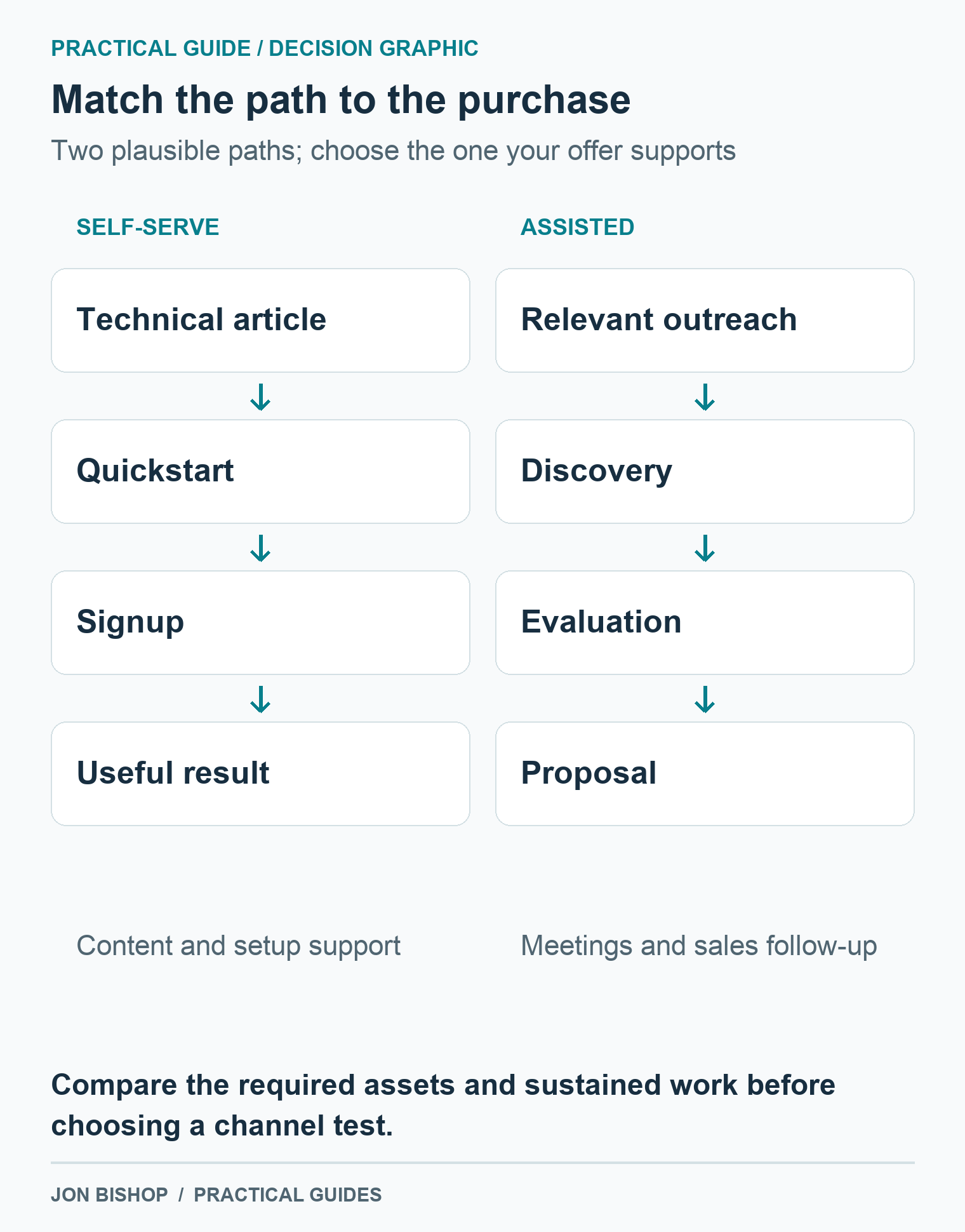
These are illustrative paths, not required funnels. Evaluate the work needed to move a suitable person through your actual buying process.
Count the work you can actually sustain
Inventory four things: time, money, skills, and existing assets.
Time includes research, production, distribution, maintenance, analysis, and conversations. Organic acquisition still consumes time. Paid acquisition still needs management.
Money includes the test itself and any necessary creative, software, implementation, or outside help. Identify how much you can spend without depending on an optimistic result.
Skills affect the quality you can produce now. A founder who can explain a difficult technical problem has a different starting point from someone with strong sales relationships. Neither needs to imitate a company with a large content team.
Assets include customers willing to give feedback, a useful repository, documentation, an existing audience, partner relationships, and material you have already written. An approach that uses these assets may be easier to execute well.
Be realistic about capacity. If you can spare a few hours each week, one focused approach may already be plenty. Publishing one tutorial and sharing it in appropriate places can be a single coordinated approach; it does not have to count as several independent channel programs.
Compare candidates against your actual constraints
Suppose a founder can spend four hours a week and already has a working debugging example. The following fictional comparison makes the choice more concrete:
| Candidate | Existing advantage | Missing prerequisite | First decision |
|---|---|---|---|
| Helpful community contribution | Useful example ready to share | Verify relevant discussions and contribution rules | Investigate audience fit before preparing the contribution |
| Paid search | Buyers might search for the problem | No query evidence, campaign page, or tracking yet | Research demand and setup effort before buying traffic |
| Partner tutorial | Integration already works | No confirmed partner interest | Ask one relevant partner about the combined use case |
Community participation is the easiest candidate to investigate in this situation, provided the audience and rules support it. If they do not, the existing example is still useful for a partner conversation. Choose the next feasible test, not the channel with the most attractive theoretical reach.
Write a specific acquisition hypothesis
Use this structure:
> We believe [specific audience] experiences [problem]. We can reach them through [place and method] with [useful offer]. If the approach is promising, we'll observe [qualified behavior] within [appropriate observation period].
For a fictional API monitoring product:
> We believe small platform teams struggle to reproduce intermittent webhook failures. We'll publish a reproducible debugging example and share it where these teams already discuss webhook problems. Interested teams can run the example and try the monitoring workflow. We'll track relevant conversations, successful setup, and whether users return to investigate another failure.
The example doesn't promise a conversion rate. It makes the audience, contribution, and value path visible.
Design the smallest useful pilot
A useful pilot needs enough effort to test the approach fairly. A single generic community post may tell you little about community acquisition. A small paid campaign with broken tracking may tell you little about paid search.
Write down:
- The audience and evidence of its problem.
- The offer and conversion path.
- The assets you need to produce.
- The time and spending cap.
- The outcome measures and customer-quality checks.
- The review date and what you will inspect.
- What would make you stop, change the execution, or continue.
Use an observation window appropriate to the mechanism. Search content, an event, and direct outreach do not produce evidence on the same timetable. Set an early check for execution problems separately from the later assessment of customer outcomes.
Read the result before judging the channel
When results disappoint, walk through the path. Did the right people encounter the offer? Did they understand it? Did they take the next step? Could they get value? Did the users who succeeded resemble the customers you want?
These questions lead to different actions. You might need to change the audience, improve the offer, repair onboarding, or abandon the approach. “The channel doesn't work” is often too broad a conclusion from a small pilot.
Small samples can still reveal useful problems and promising conversations. They usually cannot establish a precise long-term acquisition cost or prove that one approach will outperform another.
Choose an approach you can execute well enough to learn from. Record what happened and use that evidence to decide the next move.
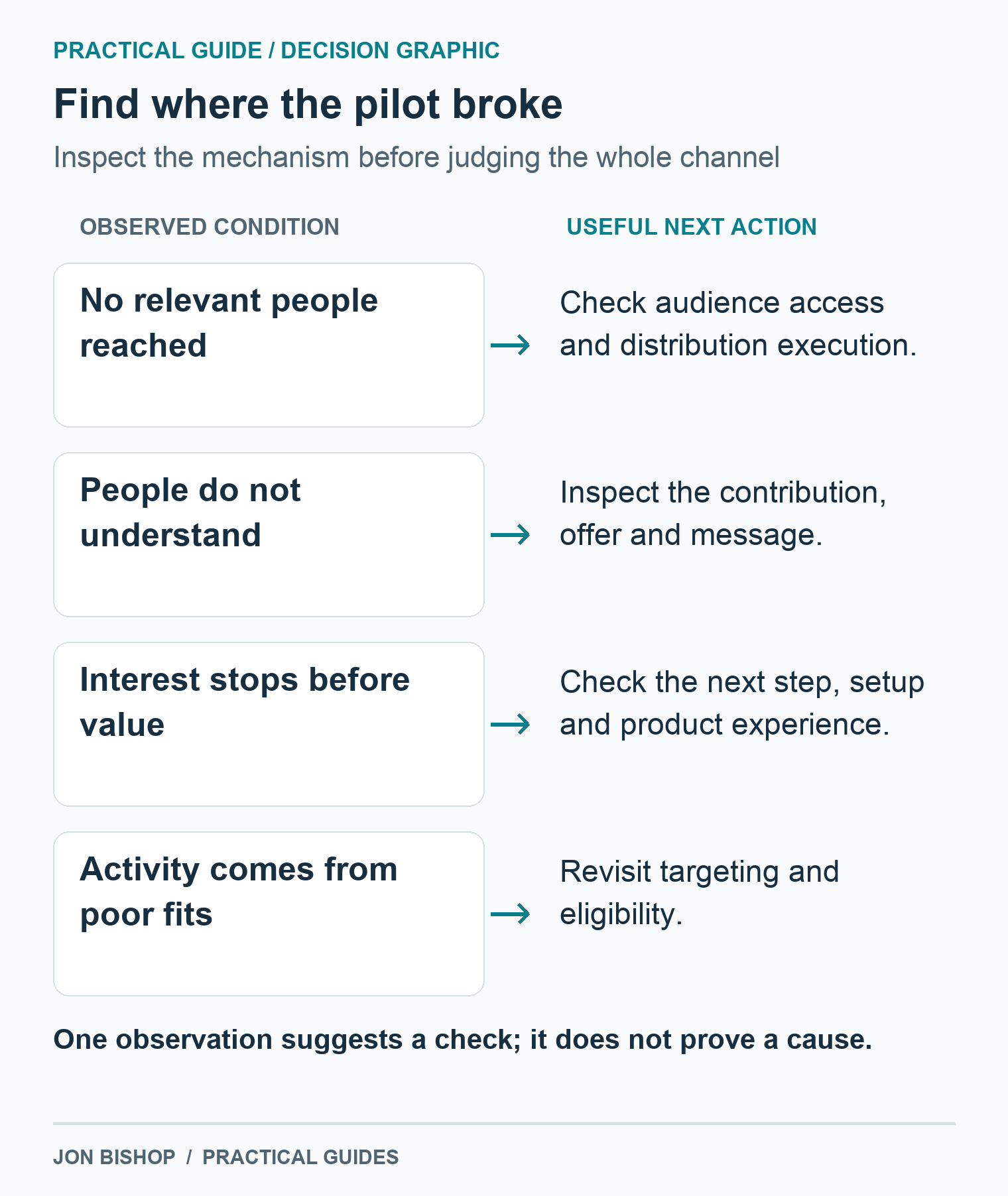
Review each failure point using the actual pilot records. Traffic or interest alone cannot identify which part needs to change.
Finish with a decision you can act on
Before starting, be able to name the audience, offer, next action, owner, resource cap, and review condition. If a field is unknown, assign a research step rather than hiding the gap in the plan. Keep the complete brief and results in the downloadable template below.
Use the channel-test template
Download the marketing channel test brief. It includes the blank brief, a results log, a completed fictional example, and review questions.
Continue with your next decision
Next, use the measurement plan guide to define the records your channel test needs before you start.
This guide builds on Jon Bishop's marketing-plan skill.
Explore the SaaS growth guides and templates to choose another problem to work on.