COURSE READING AND WORKSHEETS
How to create a SaaS measurement plan
A useful measurement plan connects a decision to trustworthy evidence. Start with what the team needs to decide, define the behavior that would inform it, and agree on how that behavior will be recorded and reviewed. Add tools after the definitions are clear.
The working output is a compact event dictionary and a report tied to one decision. Start with one meaningful workflow; add measures when they change what you can decide.
Begin with decisions, not dashboards
Write one decision in practical terms. “Decide whether to improve integration setup before increasing acquisition” tells you more than “Track activation.” It identifies the tradeoff and the behavior you need to understand.
List the questions behind the decision. How many eligible accounts start setup? How many complete it? How many reach a useful result? What prevents the others from continuing? Quantitative records can show where to investigate, while customer conversations and support notes can help explain why.
A dashboard without a decision owner often accumulates numbers nobody uses. Assign someone to review the evidence, state the limits, and propose the next action. Keep the first plan small enough to maintain.
Define a result that reflects customer value
Choose behavior that indicates progress toward the job the customer came to do. A page view, button click, or login may be useful diagnostic evidence, but it does not automatically establish value.
For a fictional API monitoring product, integration_connected could show that setup succeeded. test_failure_investigated could represent a deeper result, provided the team defines what “investigated” means. Opening a failure screen is weaker evidence than recording an investigation outcome.
Describe the limitations of the event. A recorded outcome may still be incorrect or unhelpful; customer feedback can test that interpretation. Do not rename an easily captured action “activation” and assume the business question is solved.
If the product has several valuable workflows, begin with the one relevant to the decision. Expanding coverage is useful when it changes what the team can decide.
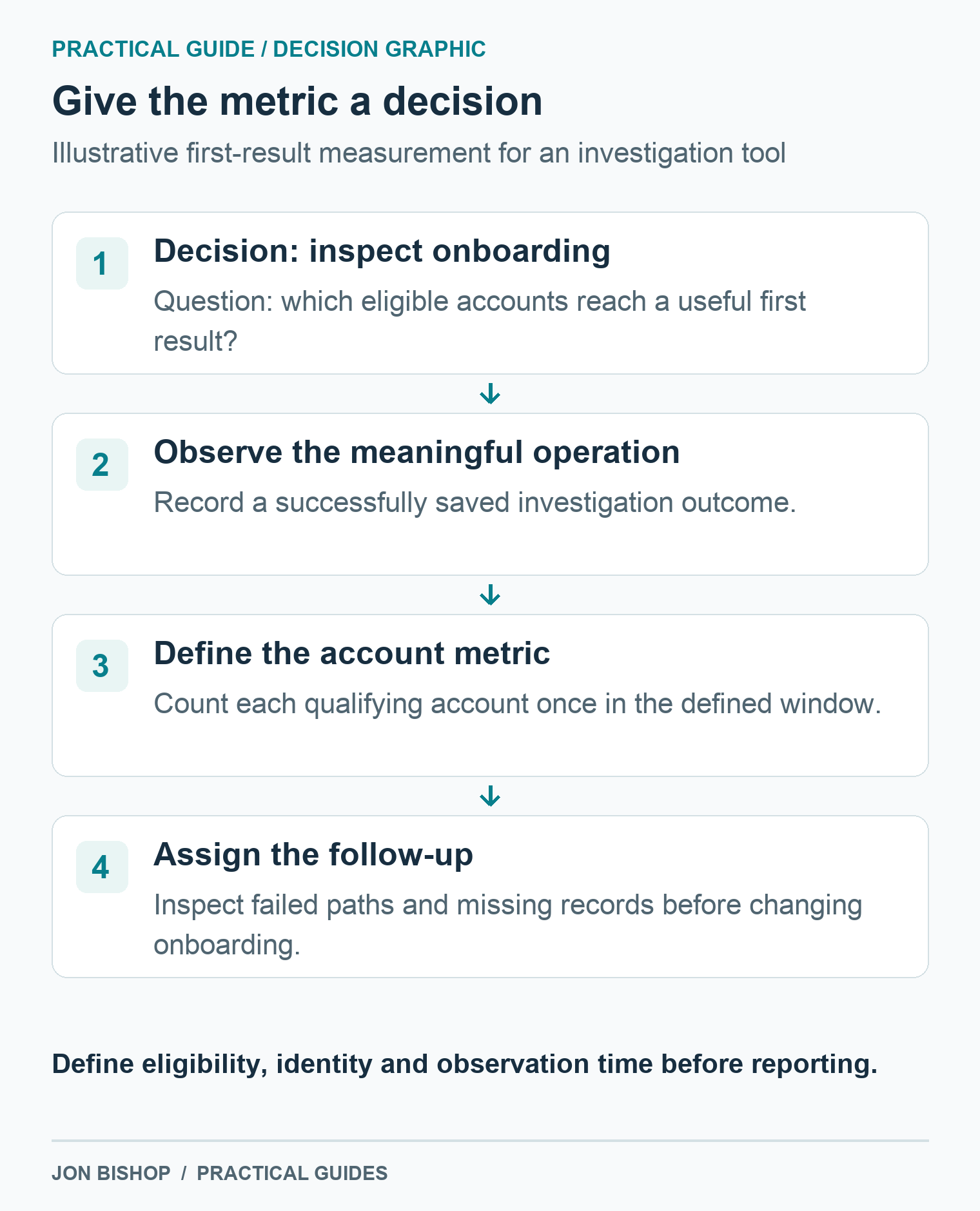
This connects the report to a decision. A complete event and metric definition still needs identity, deduplication, eligibility and observation-window rules.
Write an event dictionary
Each event needs a stable name and an exact trigger. Document the entity being measured, the source, allowed properties, ownership, and situations in which the event should not fire.
| Event | Trigger | Unit | Purpose |
|---|---|---|---|
| account_created | A new account record is successfully created | Account | Establish a starting cohort |
| integration_connected | A supported integration passes its connection check for the first time | Account and integration | Observe setup completion |
| test_failure_investigated | An investigation outcome is successfully saved for a failure | Account and investigation | Observe the chosen result |
These are fictional definitions for illustration. Your product may need different triggers. Specify whether retries, repeated actions, imports, and updates create events. An event that fires before an operation succeeds can overcount completed work.
Include an event identifier and occurrence timestamp where appropriate. Record a definition version when a meaningful change would affect comparisons. Avoid adding sensitive payloads or free-text customer material when a categorical property answers the question.
Separate raw events from the metric you count
An event may occur more than once while an account qualifies for a metric only once. For example, a product can record each successful integration connection for operational analysis, while an account-level setup metric counts the first qualifying connection. Document which interpretation your dictionary uses.
For the fictional investigation event, test these cases before reporting:
| Case | Expected record | Effect on first-result account count |
|---|---|---|
| First outcome saved successfully | One completion event | Account qualifies once |
| Same save is retried | No additional completion for that operation | No change |
| A different investigation is completed | A separate valid completion | No additional first-result account |
| Save fails | No completion event | No change |
Choose a stable deduplication key for the operation. Then define aggregation separately, so event volume cannot silently become an account conversion count.
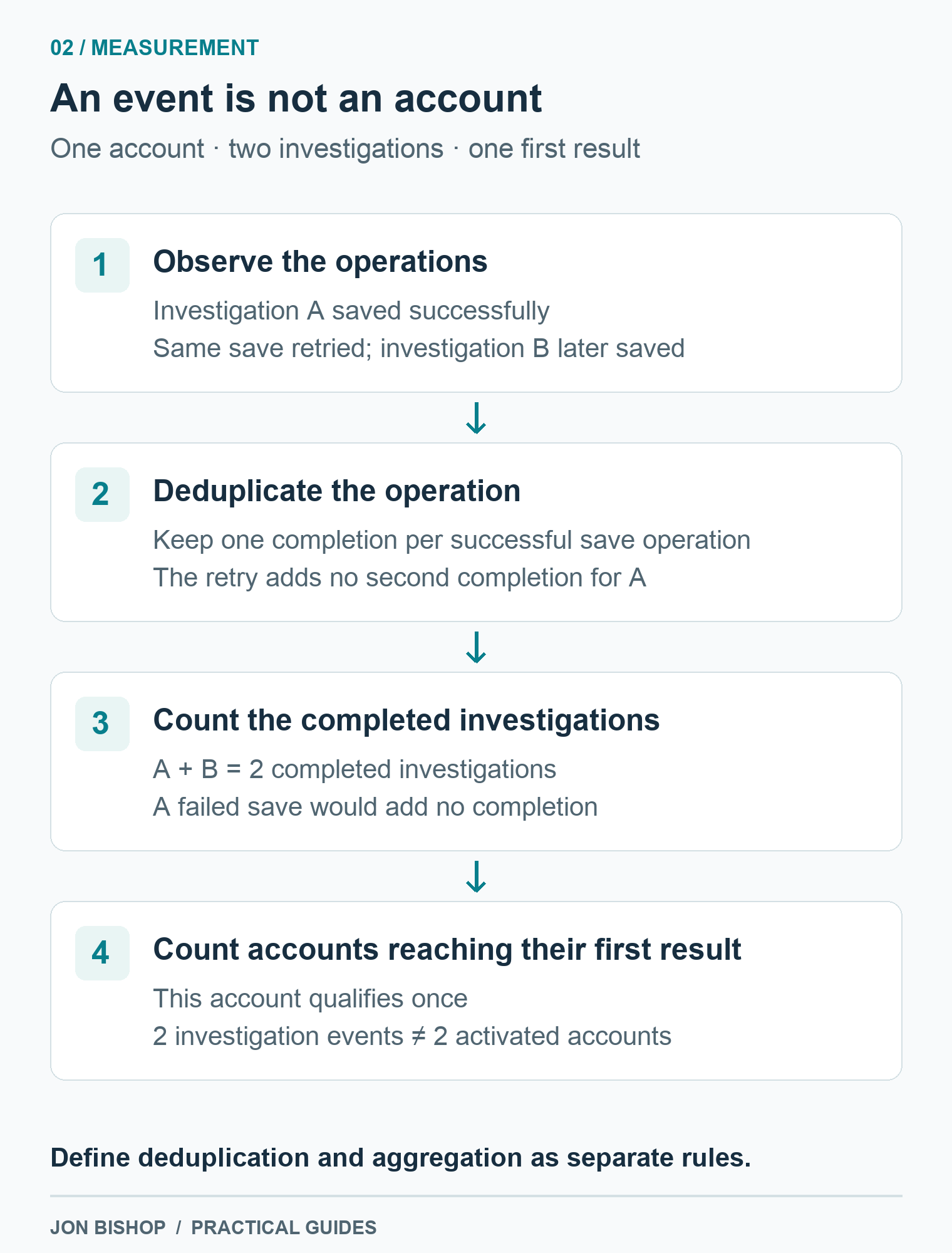
Count successful operations first, then apply the account-level aggregation rule. The example produces two completed investigations and one qualifying account.
Make identity and counting rules explicit
Decide whether the report counts people, accounts, integrations, or actions. In a collaborative product, several people may complete one account's setup. Counting all their clicks as separate activated accounts produces a misleading result.
Define how authenticated users relate to accounts and what happens when one user belongs to several accounts. Decide whether anonymous activity needs to be connected at all for the current decision. If it does, document the permitted mechanism and its gaps instead of assuming perfect attribution.
Exclude internal testing and other ineligible activity using an explicit rule. Retain a way to inspect excluded records when checking quality. Define deduplication around the actual event or business operation, rather than removing events merely because they happened close together.
Collect only the identifiers and properties needed for the question. Your plan should make access and retention decisions visible to the people responsible for them without turning every analytics event into a copy of the customer database.
Specify cohorts and observation windows
A conversion rate needs a numerator, denominator, and time rule. “Accounts reaching the result divided by accounts created” remains ambiguous if some accounts have had one day to progress and others have had a month.
For an illustrative report, you could measure eligible accounts created during a stated week that reached the result within seven days of creation. Only compare fully observed cohorts for that seven-day measure. Show newer cohorts as incomplete instead of treating them as failures.
Choose the window to match the workflow and decision. Seven days is an example, not a standard. A product used for a monthly task needs a different interpretation from one used many times a day.
Document the timezone, eligibility rules, source, and handling of deleted or merged accounts. If a definition changes, mark the comparison break or recalculate consistently where the records support it.
Test the records against real behavior
Walk through the expected journey in a test account. Confirm the event fires when the operation succeeds, includes the intended properties, and attaches to the right entity. Test a failure, retry, duplicate delivery, and repeated valid action.
Then reconcile a small sample with the underlying application records. A working dashboard cannot tell you by itself whether an integration emitted events twice or a browser blocked some collection. Use a suitable authoritative record for the operation you are measuring.
Record known gaps and the date of the check. If capture is incomplete, label the report and avoid interpreting missing events as definitive customer inactivity. Instrumentation problems and customer behavior are different explanations that need different fixes.
Repeat quality checks after changes that could affect collection or definitions. You do not need to rerun every possible check after an unrelated copy edit.
Create a report that ends with a decision
Show counts alongside rates. “12 of 30 eligible accounts reached the defined result within the observation window” is easier to assess than “40% activation.” State that the numbers are illustrative if they are examples rather than product data.
Keep acquisition source or audience breakdowns only when the group sizes and recording quality make them useful. Small groups can suggest questions, but apparent differences may be unstable. Do not declare a winner from a tiny segment without acknowledging the uncertainty.
A short report should include the decision, definitions, observation period, counts, known gaps, supporting qualitative evidence, and recommended action. Name the owner and next review condition. If the evidence is insufficient, the action may be to investigate a specific gap rather than change the product.
Use the funnel analysis guide to interpret where progress stops once the definitions are consistent.
Keep the plan current without measuring everything
Retire events and reports that no longer support a decision, while preserving the documentation needed to interpret historical work. Add a measure when the team can explain how it will change an action.
Review whether your chosen behavior still represents a useful customer result as the product evolves. A setup milestone may become easier while the underlying job remains unsolved. Better measurement follows the customer workflow instead of simply preserving the original dashboard.
Download the measurement plan and event dictionary template to document the decision, event definitions, identity rules, quality checks, and report. For a release, pair it with planning a SaaS product launch before announcing the product.
Explore the SaaS growth guides and templates to choose another problem to work on.