COURSE READING AND WORKSHEETS
How to create a SaaS messaging document
A messaging document gives your team a shared explanation of the product, its value, and the evidence behind its claims. Build it from a specific audience and buying situation, then adapt that explanation to the questions people ask in each channel. Keep it short enough to use when writing.
Decide where the document will help
Name the work it should support: a launch page, an evaluation email, a sales conversation, or a campaign brief. A reference designed for every conceivable situation can become too broad to guide any of them.
Choose one primary audience and the action you want that audience to consider. Include secondary roles when they have a materially different concern, such as a reviewer assessing access requirements or a buyer approving the purchase.
Use the positioning guide to establish fit and alternatives first. Messaging expresses that choice in language the reader can understand. If the team cannot agree on whom the offer serves or what makes it relevant, copy variants will not settle the underlying question.
Assemble evidence before drafting claims
Gather customer observations, product facts, demonstrations, support questions, and approved results. Record where each item came from and what it can legitimately support.
Customer language is useful because it shows how people describe their work. It does not mean every phrase belongs on a page unchanged. Preserve the meaning while making the explanation clear to someone who was not in the original conversation.
Mark direct quotations separately from paraphrases. Do not turn an approximate interview note into an attributed quote. Keep confidential details out of the working copy unless the people using the document need them and the workspace is appropriate.
The customer interview guide explains how to collect this material without supplying the answers you hope to hear.
Write the central promise
Explain what a suitable person can accomplish, how the product helps, and any condition necessary to understand the offer. Avoid packing the entire feature inventory into one sentence.
A fictional example: “Investigate recurring API test failures with relevant test context in one view.” It identifies the task and a mechanism. A compatibility note can then explain the supported environment, and a demonstration can show what the view contains.
That promise is still a claim to verify for the actual product. Adding “instantly,” “effortlessly,” or “for every team” would increase what you need to prove. Remove words that imply a stronger result than the product and evidence support.
Try reading the sentence without the company name. Can the reader tell what kind of work it helps with? If not, replace broad terms such as growth, efficiency, or innovation with the task and result.
Rewrite vague copy into a verifiable explanation
Take the fictional phrase “Unlock seamless productivity for modern teams.” It does not identify the job, mechanism, or fit. A more concrete draft is: “Investigate API test failures with relevant test records in one view.”
Now attach the evidence and next step: show the records included in a supported sample, state compatibility, and offer to check whether the workflow fits. If you cannot demonstrate that view, revise the claim rather than treating the sentence as approved because it sounds clearer.
The test is straightforward: can a suitable reader explain the task, expected output, and next action after reading the copy? Clarity makes a claim assessable; it does not make the claim true.
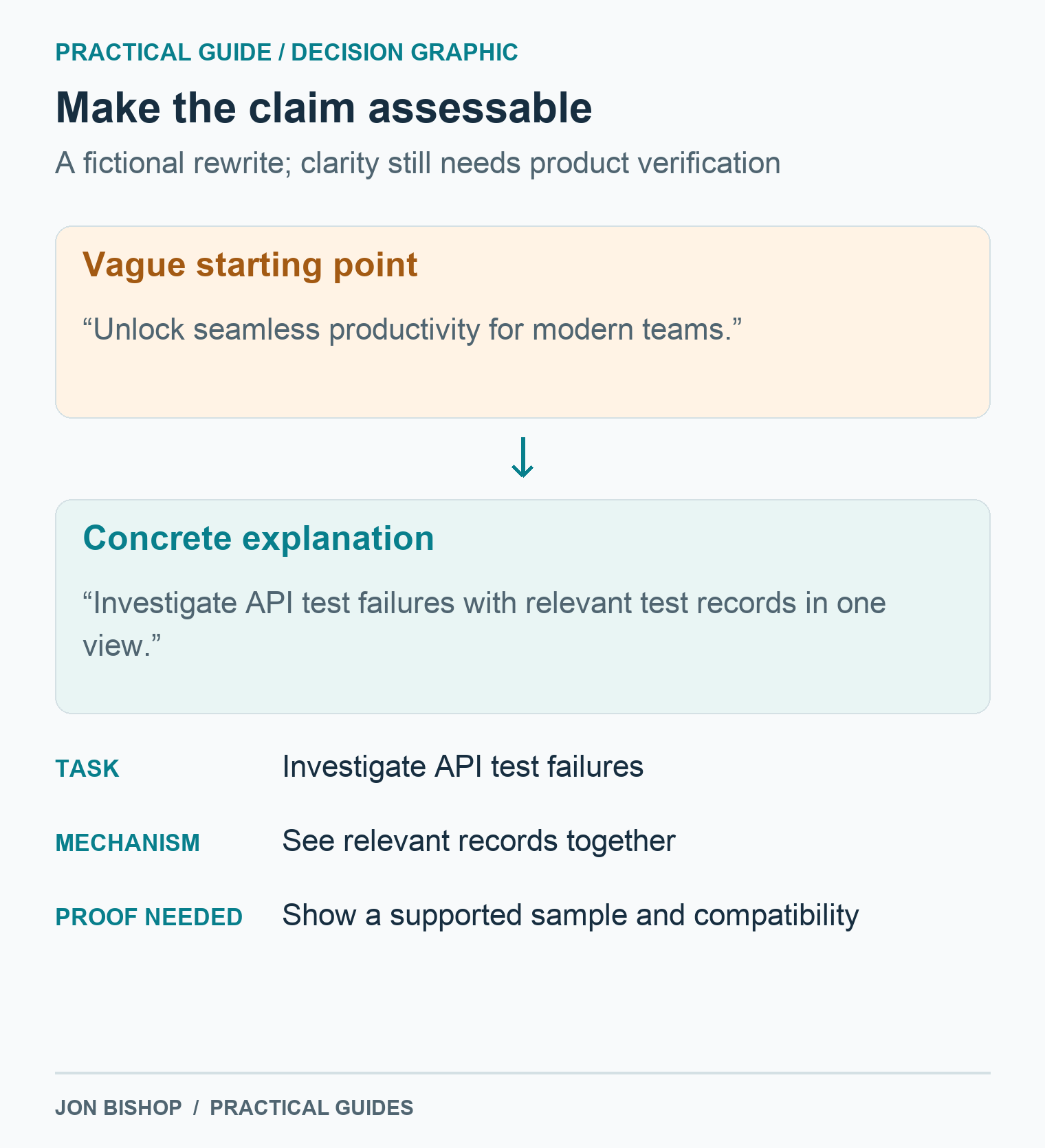
The fictional rewrite makes the task and mechanism assessable. It does not establish that a real product can deliver the promise; verify the sample and fit conditions.
Build a message hierarchy
Give the reader the most useful explanation first, then support it with a few distinct points. A supporting point should answer a question or explain a meaningful part of the promise.
For the fictional monitoring product, the hierarchy could be:
- Main explanation: investigate recurring API test failures with relevant context in one view.
- Workflow point: review connected test records without manually collecting each source.
- Collaboration point: save an investigation outcome that teammates can review.
- Fit point: check supported integrations before beginning an evaluation.
These are illustrative product claims, not verified capabilities of an actual offering. Each would need corresponding proof. They also answer different questions; four variations of “save time” would add little information.
Connect each point to a product fact, a demonstration, or an approved customer result. Readers should be able to assess the mechanism instead of taking the adjective on trust.
Separate capabilities, benefits, and results
A capability is what the product does. A benefit explains why that action may help the customer. A measured result describes what happened in a specific situation.
“Shows relevant records together” is a capability. “Helps you review the investigation context” explains its use. “This customer reduced median review time during the evaluation” is a result that requires a defined measure, period, and supporting evidence.
Keep these levels visible in a claim ledger. If you have only a product demonstration, use it to support the capability. If you have measured customer evidence, state its scope and limits rather than implying every buyer will obtain the same outcome.
The case study guide explains how to turn a real customer result into a publishable account. A hypothetical example can explain a workflow, but it should remain clearly hypothetical.
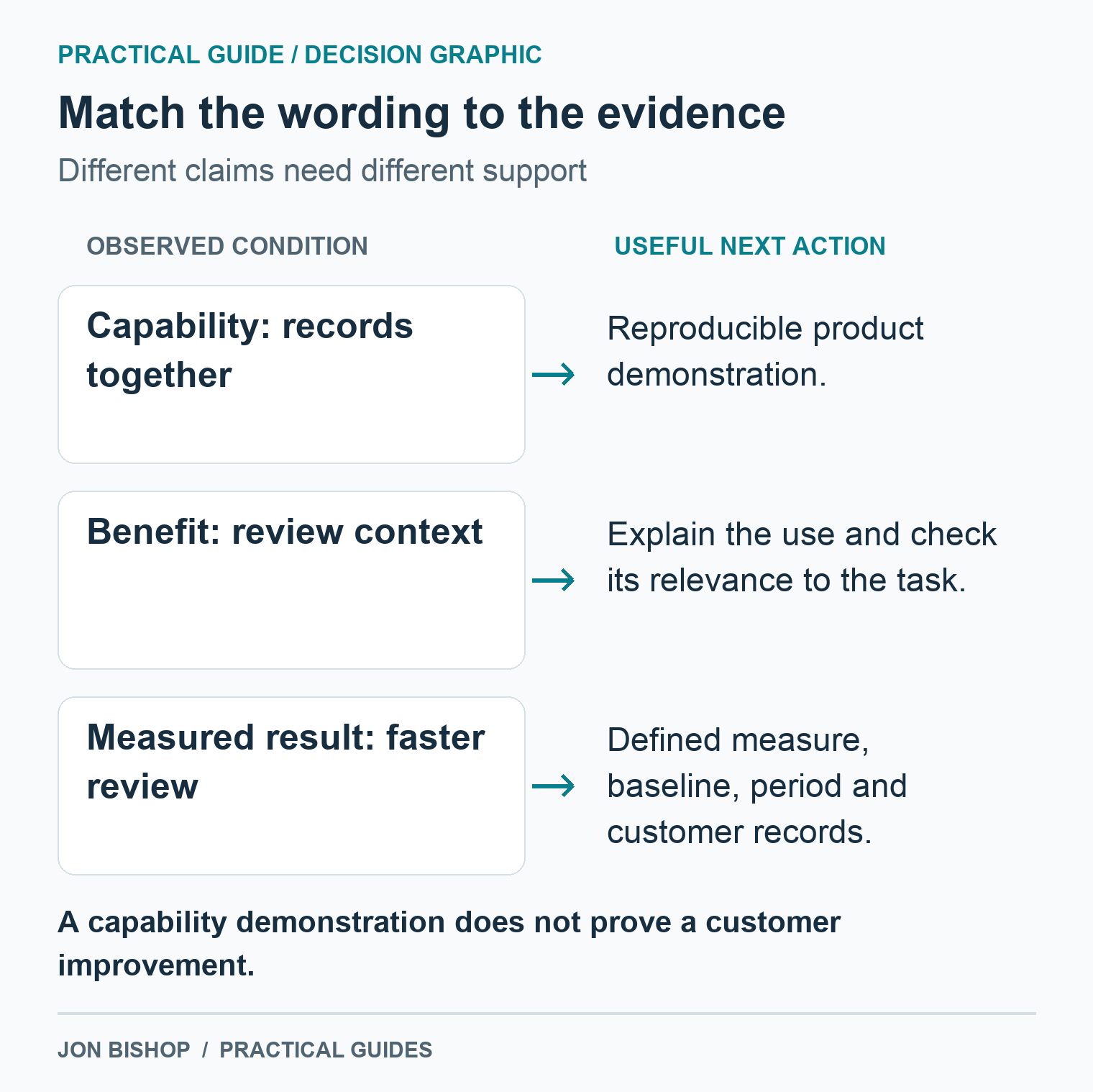
Keep capabilities, benefits and measured results separate in the claim ledger. Preserve the scope of customer evidence when adapting copy.
Answer objections with useful information
List the questions people actually ask, along with important fit questions they need answered. Compatibility, setup effort, price, support, access, and how the product differs from an existing workflow may matter more than a slogan.
For each question, write a direct answer, its supporting source, and the person responsible for keeping it accurate. If the answer is unknown, identify the follow-up instead of filling the gap with reassuring language.
Avoid forcing every objection into a positive claim. If the product does not support a required environment, say so. If an evaluation includes assisted setup, explain the scope. Accurate expectations improve the quality of the next conversation.
Decide which answers belong beside the offer and which can be linked as additional detail. A compatibility requirement that determines eligibility should not be hidden until after signup.
Adapt the message to the setting
A launch page must establish relevance quickly. An email to an existing customer can begin with a known workflow. A sales conversation can ask a question before presenting the explanation. Keep the underlying promise and limits consistent while changing the order and depth.
For each format, document the reader's starting knowledge, the question to answer, the supporting evidence, and the next action. This gives the writer a useful brief instead of a rule to repeat the same paragraph everywhere.
Write emails as a real person addressing a particular situation. Make the request clear and provide a way to reply when you can support replies. Do not imply personal familiarity or individual research that did not happen. The source notes on one-to-one communication are most useful as a reminder to make contact understandable and accountable.
Test comprehension before preference
Ask suitable readers what they believe the product does, whom it serves, and what would happen after the next action. Ask what remains unclear and what evidence they would need to continue.
Record misunderstandings separately from preferences. Someone disliking a word is different from someone expecting an unsupported capability. Prioritize corrections that affect understanding, fit, or action.
Test variants around a specific uncertainty, such as whether readers understand the workflow or the evaluation terms. If you change the audience, offer, promise, and call to action together, you may improve a response without knowing what caused it.
Maintain a usable reference
Assign an owner and version date. Keep the central explanation, supporting points, proof, objections, and format examples close together. Link to source records where appropriate rather than copying every research note into the document.
Review claims after relevant product changes or new customer evidence. Mark outdated wording so it does not remain in circulation as an equally valid alternative.
Download the SaaS messaging document template for a compact reference with claim tracking and channel briefs. Use it to brief a writer, prepare a campaign, or keep a sales explanation consistent.
If you have a real customer outcome to support the promise, use the case study guide to document the result and agree on its publishable scope.
Explore the SaaS growth guides and templates to choose another problem to work on.