COURSE READING AND WORKSHEETS
How to write a SaaS case study with credible evidence
A useful SaaS case study shows how a real customer addressed a specific problem, what changed, and what evidence supports the result. Choose a story relevant to a buying question, document the work and its limits, and agree on the publishable version with the customer.
Choose the decision the story should help
Start with a question a suitable buyer asks. Can a team like ours use this product? How much effort does implementation require? What changes in the workflow? What would a useful result look like?
A recognizable logo may attract attention, but a relevant situation and credible account of the work help the reader assess fit. Choose a customer whose experience answers a real question rather than simply choosing the largest company you can name.
Use the positioning brief to identify the audience, alternatives, and difference the story could illustrate. Avoid selecting a conclusion first and asking the customer to provide a quote that fits it.
Find a story with enough substance
Look for a clear starting situation, an actual implementation or evaluation, and a result that can be described accurately. The result may be measured, such as fewer manual steps, or qualitative, such as a clearer handoff. State which kind of evidence you have.
An incomplete evaluation can still inform your internal learning, but it may not yet support a customer-success story. Do not substitute enthusiasm for a demonstrated outcome. If the product has no suitable customer evidence, publish an explicitly fictional workflow example or a product demonstration instead.
Check whether the account has unresolved concerns that would make the proposed story misleading. A useful feature result does not erase serious delivery problems elsewhere. Understand the experience before proposing publication.
Agree on participation and scope
Explain the purpose, intended channels, expected effort, and review process. Agree on who can approve the company's name, logo, attributed quotes, and any metrics or implementation details.
Participation in an interview is separate from permission to publish the resulting story. Confirm recording permission separately as well. Some customers can describe a workflow but cannot disclose the underlying data or identify their organization publicly.
Make those limits part of the brief. An anonymized account still needs an agreed scope and enough context to be useful. Remove identifying details when required, and do not imply that anonymity creates permission to disclose everything else.
Set a review process and identify the approver early. A contact who uses the product may need a communications or other reviewer to authorize publication. Record the version approved and what uses it covers.
Interview through the actual sequence
Ask the customer to describe the situation before adoption, the trigger for change, alternatives considered, implementation, use, and outcome. Include the work performed by both the customer and your team.
Useful prompts include:
- What was happening before you tried the product?
- What made this worth addressing then?
- How did you handle it previously, and what was difficult?
- What did implementation require from your team?
- What changed in the day-to-day workflow?
- How do you know the result improved?
- What remains difficult or unchanged?
Use the customer interview guide for neutral follow-ups. Ask about a specific episode or record when possible. Avoid inviting a customer to endorse an improvement figure you have not established.
Build an evidence ledger for the results
For every outcome claim, record the source, period, definition, population, and limitations. Keep supplied figures separate from numbers you calculate. Check whether the compared periods and units are consistent.
A fictional calculation illustrates the method: if a documented process previously required 10 manual checks per review and now requires six, the reduction is (10 - 6) / 10 = 40%. Those invented counts explain arithmetic only; they are not a customer result or a benchmark.
Real comparisons may be less straightforward. Workload, staffing, process changes, seasonality, or the cases being reviewed may differ. State material differences instead of implying that the product caused the entire change.
If the customer provides an estimate, label it as an estimate and explain its basis. If no baseline exists, describe the current outcome without inventing a before-and-after improvement. “Now uses one shared review record” can be useful even without a defensible time-saving percentage.
Match the headline to the evidence you have
Choose wording after reviewing the records. These fictional examples illustrate three levels of support:
| Available evidence | Defensible headline direction | What to avoid |
|---|---|---|
| Comparable documented manual-check counts | How a team reduced manual checks from 10 to six | Implying a 40% reduction in total cost or time |
| Customer estimate without measured baseline | How a team describes its investigation workflow after adoption | Presenting the estimate as a measured improvement |
| Verified current workflow; no before/after result | How a team uses a shared investigation record | Inventing a baseline to manufacture a percentage |
Verify the actual result and obtain approval before publishing any real version. When the evidence changes during review, update the headline, summary, and excerpts together.
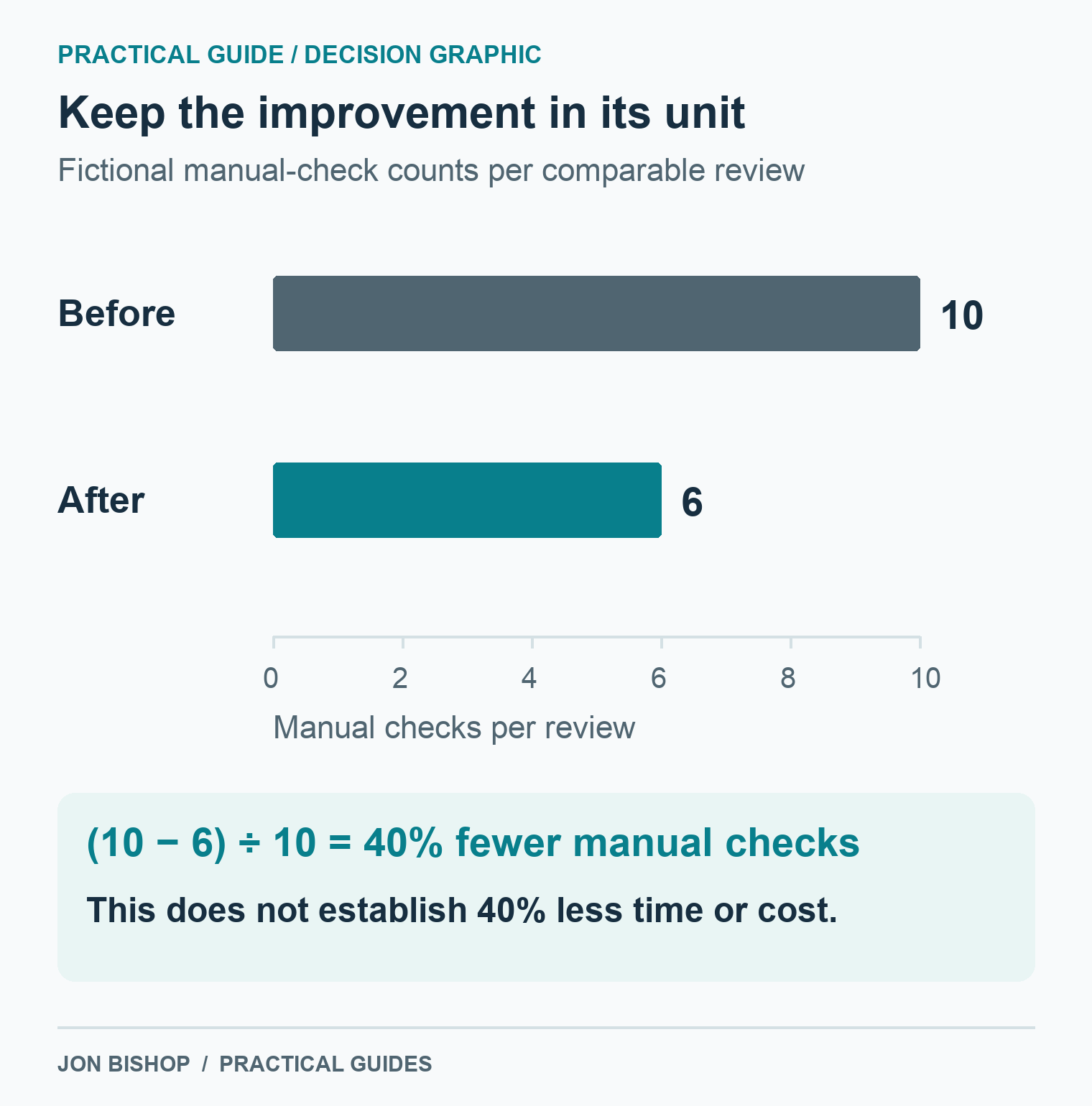
The counts are invented to explain the arithmetic. Even with real comparable records, the percentage would describe manual checks, not automatically time, cost or causation.
Distinguish the product's contribution
Describe what the product enabled and what people did with it. If your team supplied substantial hands-on assistance, include that work. If the customer changed a process at the same time, explain the change.
A result can be valuable without being attributable to the product alone. A case study is more credible when it shows the conditions under which the outcome happened. This also helps buyers assess the effort they would need to contribute.
Avoid extrapolating a short evaluation into annual savings unless the inputs and assumptions justify the estimate and the customer approves the wording. State assumptions explicitly. A measured result and a modeled future benefit are different claims.
Structure the story around the work
Use a title grounded in the specific result, then provide a short summary, customer context, starting problem, decision, implementation, changed workflow, evidence, and remaining limits.
Keep enough operational detail for a reader to understand the mechanism. “The team became more efficient” explains little. Describing which manual collection steps changed, who reviewed the output, and what decision followed helps the reader evaluate the story.
Use quotes to add the customer's perspective, not to avoid supporting factual claims. An accurate attributed opinion does not prove a metric. Do not combine fragments from different answers into a quotation that changes the meaning.
Finish with a next action relevant to the story, such as checking compatibility or seeing the demonstrated workflow. A case study about a supported use case should not promise the same outcome for every environment.
Review accuracy before presentation
Have the relevant internal owner check product behavior and calculations. Then send the customer the complete proposed version, including headline, quotes, figures, identifying details, and the intended publication scope.
Record requested changes and confirm the final approval. If the customer removes a figure, adjust the headline and surrounding claims as well. A story should remain coherent after review rather than preserving an unsupported promise in the summary.
Keep the evidence ledger available to the people responsible for the content. Do not publish underlying customer records simply to make the article look well sourced. The public explanation should provide useful provenance without exposing confidential material.
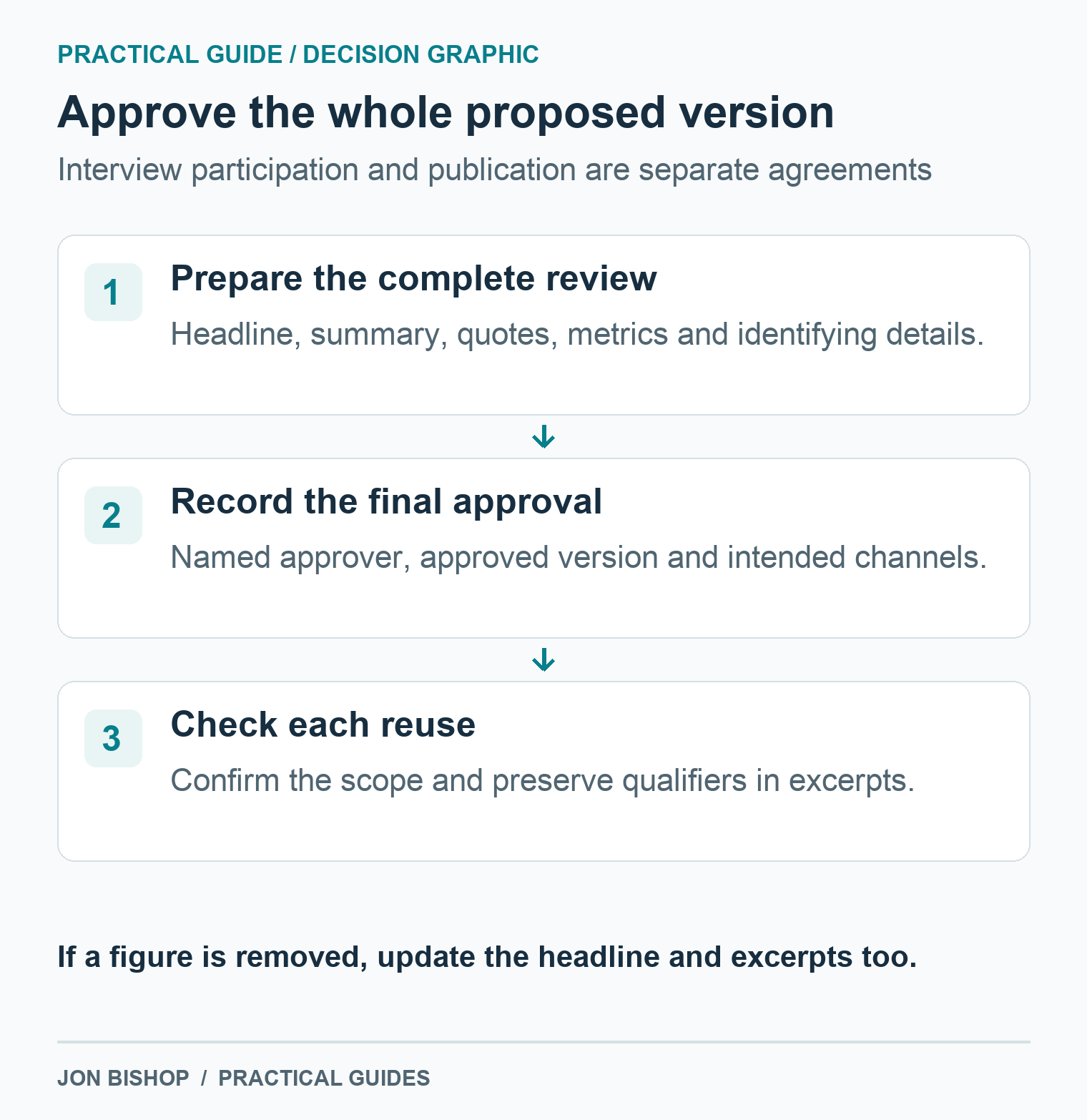
This is an editorial review flow. A research conversation does not authorize publication or every future use of a customer’s words, identity or metrics.
Reuse only what the approval covers
A short sales excerpt, a website quote, and a paid advertisement may require different uses of the material. Check the agreed scope before repurposing. Preserve qualifiers when shortening a result so the abbreviated version remains accurate.
Use the messaging document to record approved claims and limits. Review the story when a material product change makes its implementation details misleading, while preserving its historical context.
Download the SaaS case study interview and evidence kit for the brief, questions, result ledger, story outline, and approval record. The kit helps prepare a real story; it does not authorize publication on a customer's behalf.
Then record the approved claims and qualifiers in your messaging document so excerpts remain consistent.
Explore the SaaS growth guides and templates to choose another problem to work on.