COURSE READING AND WORKSHEETS
How to plan technical content people can use
A technical content plan should identify work your audience needs to finish and material your team can explain accurately. Choose topics through reader evidence, product relevance, and the ability to deliver a useful answer. Finish with a production brief and a distribution route, rather than a calendar of titles alone.
Name the reader's task
Start with a specific job: reproduce an error, compare implementation approaches, configure an integration, or decide whether a workflow fits. A topic such as “webhooks” is a subject area; “diagnose duplicate webhook deliveries without creating duplicate orders” describes a task.
Separate the learner from the buyer where relevant. A useful implementation article may help a developer evaluate a product while another person approves the purchase. The content should solve the stated task without pretending that every reader is ready to buy.
Use the audience guide to identify context and requirements. Avoid producing separate articles for company sizes or funding stages unless those differences change the answer.
Collect questions from actual work
Look at support conversations, implementation questions, customer interviews, documentation gaps, and public discussions you are permitted to use. Record the wording, context, source, and date. Remove confidential details before moving material into a broader editorial workspace.
A repeated question can identify friction, but frequency alone does not determine priority. One uncommon question might block a valuable evaluation. A frequent basic question might already have a clear answer that simply needs a better route from the product.
Distinguish a content problem from a product problem. An article can explain an error and recovery path; it cannot make an unsupported integration work. If the product behavior is broken, assign the repair instead of making content carry the promise.
Choose the appropriate format
Match the output to the task. A tutorial walks through a reproducible result. A reference explains supported behavior and constraints. A comparison helps select between approaches. A troubleshooting guide narrows possible causes and shows how to inspect them.
Do not make every question a long blog post. A concise documentation update, sample repository, or diagnostic checklist may be a better answer. Keep one primary home for the task and link to supporting resources rather than creating several near-identical explanations.
For a fictional order-processing product, a duplicate-delivery tutorial might use synthetic events and a local example. A companion reference could define retry behavior. The tutorial teaches the workflow; the reference documents the actual contract. Neither should claim production reliability from a demonstration alone.
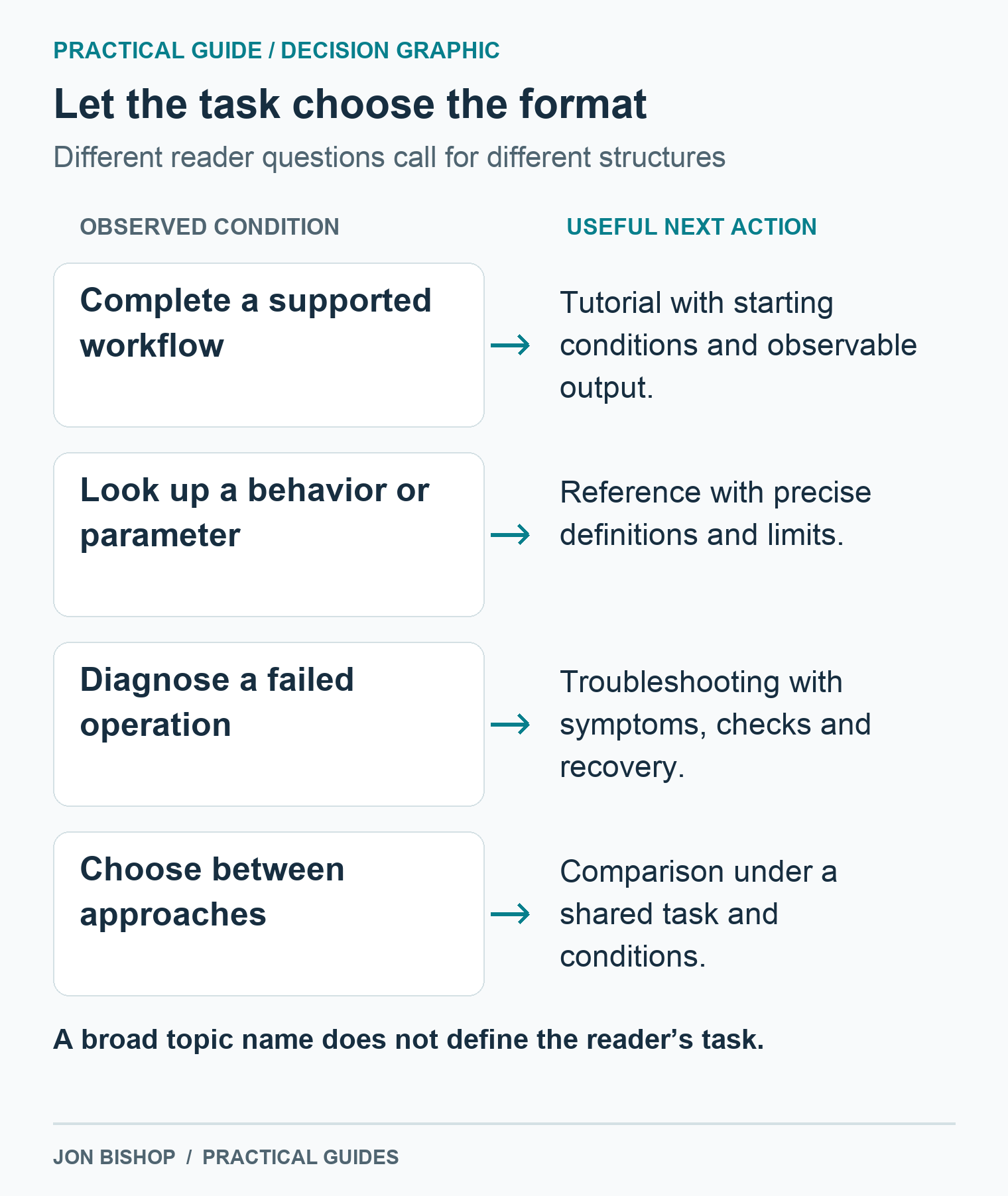
Choose the format from the task. Confirm that the product, available proof and reviewer can support the proposed content before commissioning it.
Compare topics using evidence and feasibility
Use consistent criteria: reader consequence, relevance to your product, existing answer quality, available proof, production effort, and a feasible way to reach the audience.
| Candidate | Reader need | Available material | Main obstacle | Editorial decision |
|---|---|---|---|---|
| Diagnose duplicate deliveries | Prevent repeated downstream work | Tested sample and support questions | Product reviewer needed | Prepare a reproducible brief |
| Broad history of event-driven systems | General learning | Opinion and background knowledge | Weak connection to a next task | Defer for this campaign |
| Configure an unsupported integration | Concrete implementation need | No supported workflow | Product compatibility | Do not promise a tutorial |
This is a fictional comparison, not measured search demand. Research search intent when it affects the decision, but do not invent volume or treat a popular phrase as proof that your team can provide a useful answer.
Build the proof before polishing the prose
Identify what you will demonstrate and under which conditions. Specify environment, versions where relevant, inputs, expected output, failure cases, and limitations. Use synthetic data or material approved for the intended use.
Run the example from the documented starting point. A snippet that works only in the author's already-configured environment is an incomplete tutorial. Ask a reviewer to follow the instructions without supplying hidden steps.
Retain evidence of the run and distinguish a reproducible example from a modeled result. If the article compares approaches, use comparable tasks and explain differences. Recheck changing product details before publication.
Write a brief that supports production
Include the reader, task, starting knowledge, promised output, scope, source material, demonstration, reviewer, and next action. State what the piece will not attempt to answer when that boundary prevents confusion.
Choose the next action because it helps the reader continue: use the sample, check compatibility, inspect a reference, or evaluate a supported workflow. A relevant product offer can sit beside an independently useful explanation.
Avoid committing to a publishing cadence until you understand review and maintenance effort. One reliable article can take more work than several unsupported summaries; plan capacity around the complete workflow.
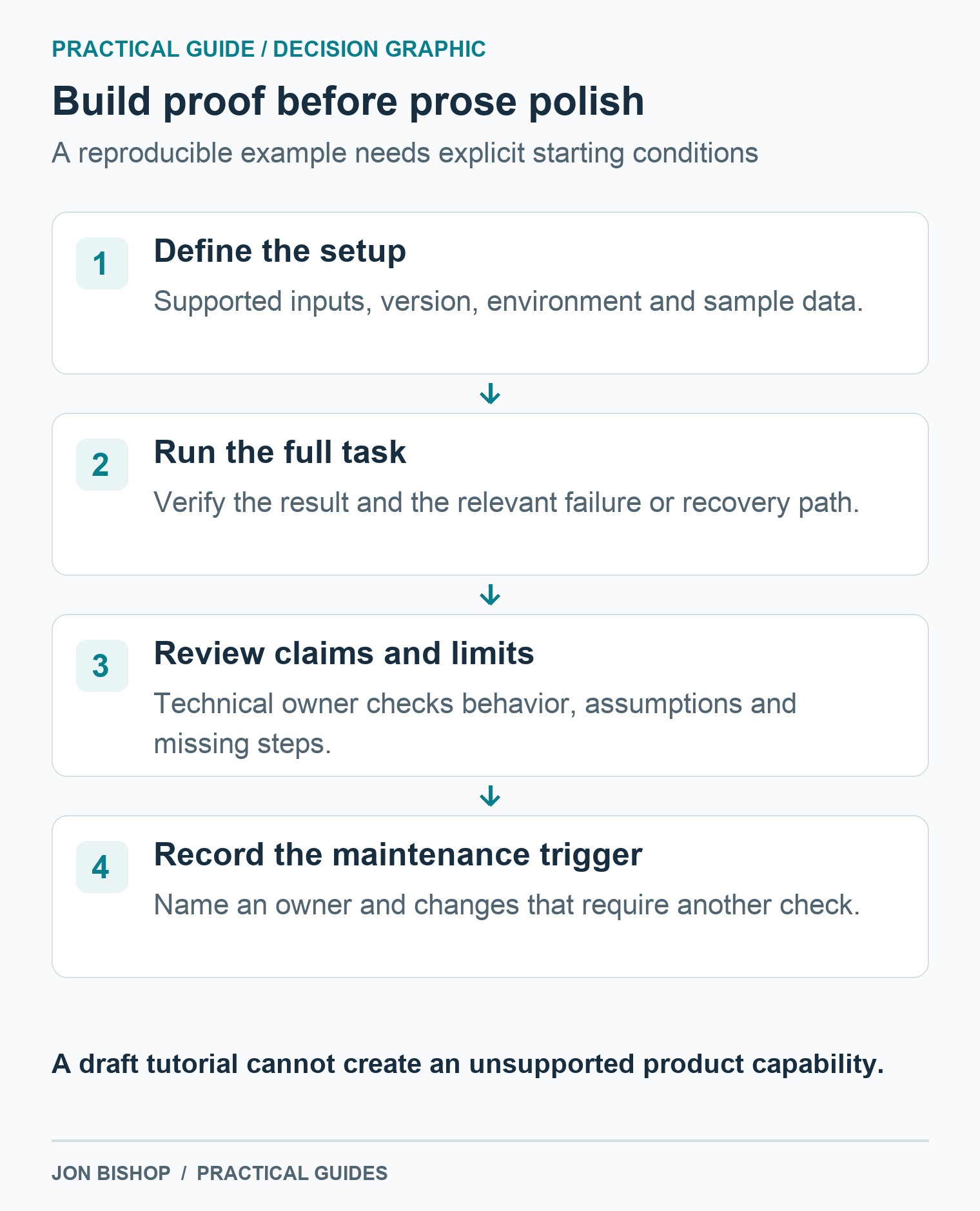
This keeps the explanation reproducible and bounded. An unsupported integration should not become a tutorial merely because the topic is attractive.
Plan distribution before publication
Identify where the task is being discussed and what contribution fits that setting. Verify destination rules before proposing a named placement. A copied headline posted everywhere is not a distribution plan.
Use the technical distribution guide to prepare a contribution, owned-audience explanation, and a useful next action. The source article remains the complete answer; adaptations should provide context in their own setting.
Review outcomes and maintenance needs
Track whether relevant readers use the example, reach the next step, and ask questions that reveal missing instructions. Page views alone do not establish task completion or qualified demand.
Assign a maintenance owner and a review trigger, such as a relevant API change or a reproduced reader failure. Retain the scope and tested environment so the next reviewer knows what the article promises.
Download the technical content brief and topic worksheet. It helps turn a question into an answer your team can produce, validate, distribute, and maintain.
Explore the SaaS growth guides and templates to choose another problem to work on.