COURSE READING AND WORKSHEETS
How to distribute technical content with a useful contribution
Technical content distribution works best when the contribution fits a real reader question and the setting where you share it. Select a few relevant routes, adapt the explanation, and track what readers do next. Treat participation and follow-up as part of the work.
Check that the source earns distribution
Before promotion, verify that the article answers its promised task, examples work, limitations are clear, and the next action is supported. The technical content planning guide provides a production brief for those checks.
A misleading title can produce visits while wasting the reader's time. A broken sample can turn distribution into a larger support problem. Repair those issues before increasing reach.
Describe the intended reader and what they can accomplish. That description is your basis for selecting destinations; a platform name alone says little about who will encounter the work or why they would care.
Look for evidence of relevance
Find discussions, publication themes, partner workflows, or existing subscribers connected to the task. Record the observation and date. A large audience is less useful when the task is unrelated to its interests.
Separate evidence of audience presence from permission to contribute. A community can contain suitable readers while prohibiting promotion. A newsletter can cover your topic without accepting submissions.
This guide uses route types rather than recommending current named communities or publishers. Check the actual destination's current rules and editorial process before preparing a placement. Do not assume access to private lists or scrape personal contact details to manufacture distribution.
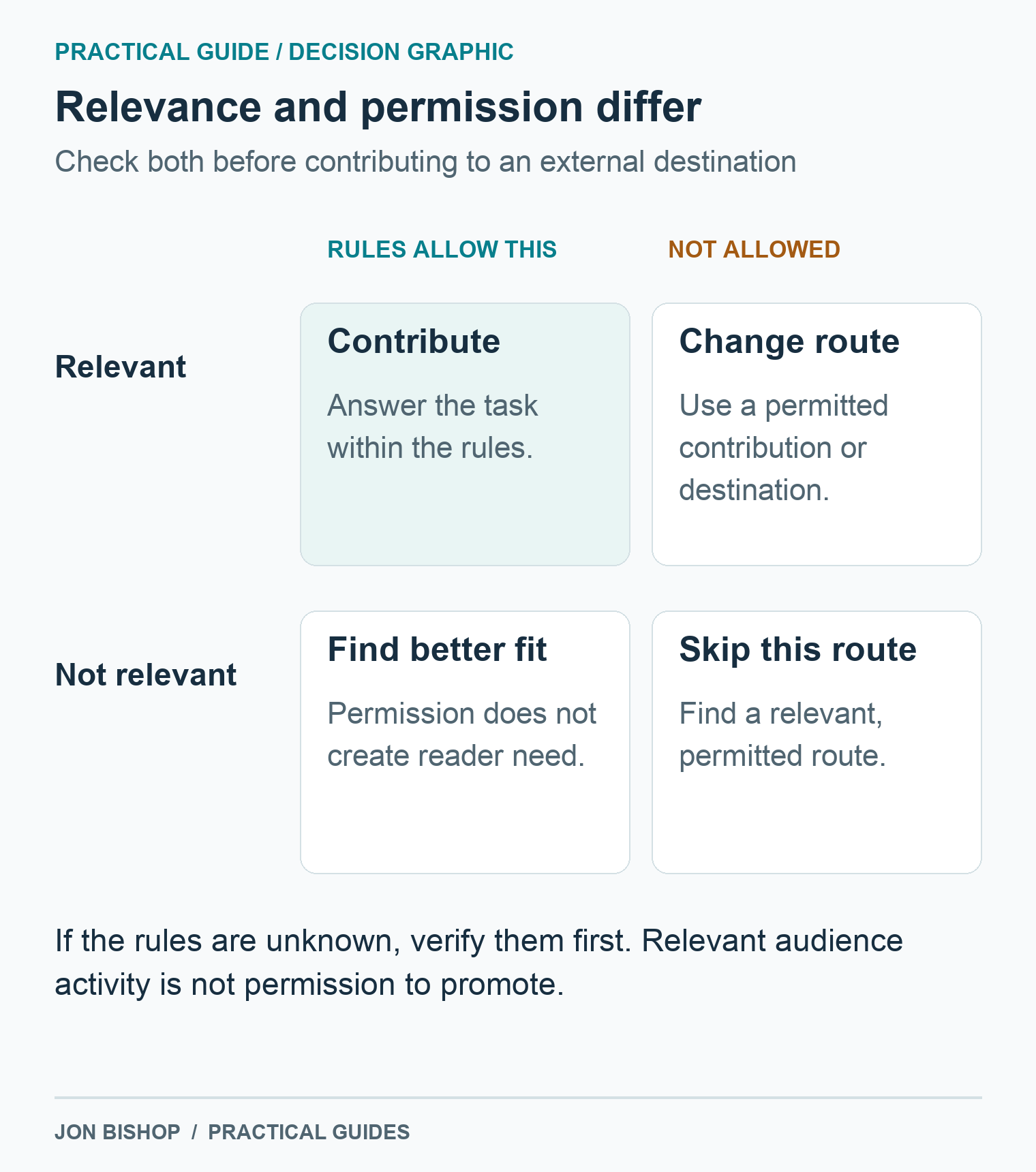
This matrix evaluates a proposed contribution, including its links and disclosure. Verify the actual destination’s current rules rather than assuming audience relevance authorizes promotion.
Choose a contribution for each setting
Adapt the article's useful part to the reader's immediate situation. A discussion reply can explain a diagnostic step. An owned email can summarize the problem and link to the tested example. A partner activity can teach the combined workflow.
| Route | Useful adaptation | Prerequisite |
|---|---|---|
| Relevant discussion | Answer the specific question, with a source when allowed | Genuine relevance and participation within the rules |
| Existing subscriber email | Explain the task, output, and who should use it | Appropriate audience and communication permissions |
| Partner collaboration | Demonstrate how the combined workflow helps | Confirmed contribution and review from both sides |
| Specialist publication | A proposal that fits its reader task | Current submission route and suitable original material |
Choose only routes you can prepare and follow through on. Participation is work, not merely a link placement.
Lead with the answer
A fictional discussion contribution might say: “If retries can arrive twice, check whether the operation is keyed by a stable delivery identifier before repeating the downstream write. In our synthetic example, the second receipt finds the saved operation and skips the duplicate write.”
That explanation must match the actual implementation and question. Add a link only when it is relevant and permitted, and disclose your relationship to the product. Do not imply that a demonstration guarantees correct behavior in every system.
Compare that with “We wrote the ultimate webhook guide—check it out.” The latter asks for attention without explaining what the reader can learn or do. A useful adaptation should remain understandable even before the reader opens the link.
Use an owned route to provide context
For people who already chose to hear from you, explain why this particular resource is worth opening. Describe the task, prerequisites, expected output, and relevant next step. Keep the subject and summary consistent with the article.
A fictional email summary could be: “This example shows one way to avoid repeating an order write when a webhook is delivered again. It uses synthetic events and a supported sample environment; the final section explains the conditions you still need to check in your own system.”
Do not send the same material repeatedly merely because it exists. Relevance to the audience and the timing of their work matter more than filling a schedule.
Coordinate a small sequence
Assign an owner for each route, its prerequisites, and the response work it may generate. Confirm partner timing before putting it into the plan. Keep a resource cap that includes adaptation and follow-up.
Stagger actions when it helps you answer questions and learn from feedback. There is no universal best posting day or fixed number of shares. Use the audience's actual setting and your team's capacity.
If a destination rejects the contribution or its rules do not permit it, record the reason and choose another suitable route. Do not disguise promotional material or repeatedly repost it to evade moderation.
Measure the path, not just the exposure
Track the contribution, relevant visits where observable, next actions, and reader feedback. Use consistent event and cohort definitions from the measurement guide.
Tagging a link can help record a source, but it does not capture every influence or prove that the contribution caused a purchase. Keep attribution gaps visible. A conversation that resolves a problem may be valuable even when a click cannot be observed.
Investigate whether the visitors fit the intended task and can use the material. High traffic with no relevant next action may indicate a mismatch in audience, promise, or the product path.
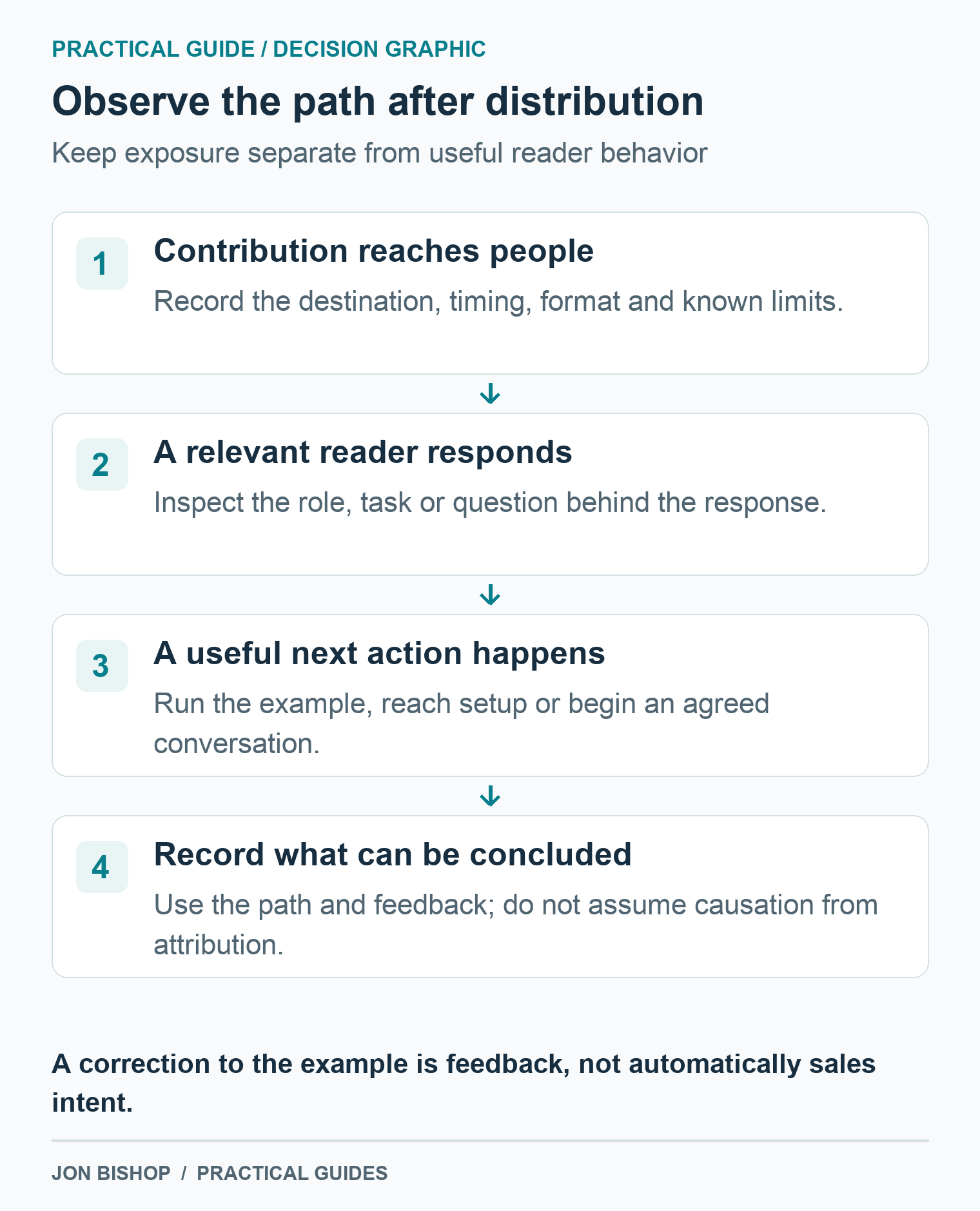
These stages are observation categories, not required conversion steps. Measure actions suited to the contribution and keep technical feedback distinct from buying intent.
Turn replies into improvements and relationships
Answer substantive questions while the context is fresh. Correct mistakes in the source when justified and communicate the correction where appropriate. If a reader identifies a different task, record it as a topic candidate rather than expanding the current article indefinitely.
An interested reader may want only the sample. Offer an evaluation when the conversation establishes a relevant need, not simply because they clicked a link. The first-customer guide helps distinguish resource interest from an evaluation commitment.
Download the technical distribution plan and results log. Use it to select a contribution you can justify, execute, and review rather than a list of places to paste the same announcement.
Explore the SaaS growth guides and templates to choose another problem to work on.