COURSE READING AND WORKSHEETS
How to analyze SaaS retention by customer cohort
A retention cohort groups customers by a shared starting condition and checks whether they return to a meaningful result over time. Define the population, activity, and observation periods before comparing rates. Keep incomplete periods visibly separate from measured inactivity.
Choose the retention question
Decide whether you want to understand repeat product value, continued paying relationships, or retained revenue. These are different measures. An account can keep paying while usage falls; revenue can grow while the number of customers falls.
This guide focuses on account-level activity retention. Use it to investigate whether accounts repeat a relevant workflow after starting. It does not calculate revenue retention or establish why a customer renewed.
State the decision the analysis informs: improve onboarding, investigate a segment, or understand a change in repeat use. The customer-fit guide can help connect the finding to acquisition without assuming that every retained account is equally valuable.
Define a starting cohort
Choose an entry event such as account creation or first completion of the useful workflow. Those definitions answer different questions. Starting at first value excludes accounts that never reached it; starting at signup includes the onboarding path.
Define the unit and eligibility. For a collaborative product, several users may contribute to one account's activity. Do not mix user logins with account retention without an explicit counting rule.
Document exclusions, source, timezone, and entry period. Keep accounts that stop in the denominator when assessing retention from the original population, unless the defined eligibility rule establishes otherwise. Removing unsuccessful accounts after the fact can inflate the result.
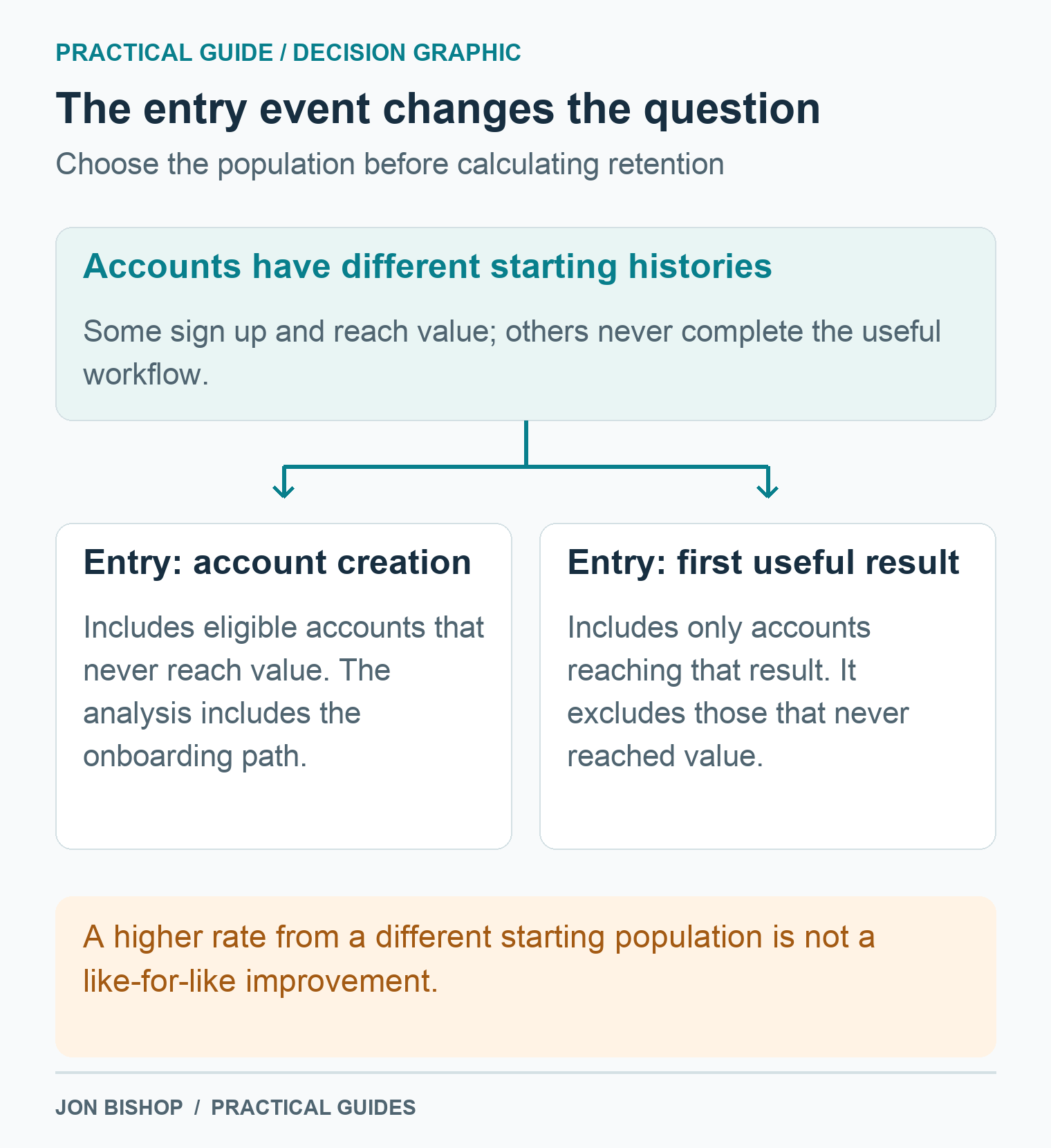
Choose the entry event to match the decision. Do not compare rates from these populations as if they represented the same onboarding and repeat-use experience.
Define what counts as returning
Choose a behavior connected to the recurring task. A reporting product might count a completed report; a product for occasional audits may require a longer observation cycle. Logging in is not automatically evidence of reaching value.
Specify whether the measure means activity in each period, activity on an exact day, or any activity after a threshold. Do not compare rates built from different definitions.
For the worked example below, each cohort enters in an enrollment month. Month 1, 2, and 3 are the next three calendar months. An account qualifies in a month if it completes at least one report during that month. This is period activity retention; a returning account can count again after an inactive month. Within-month enrollment age can vary, so a tighter account-age analysis may be needed for a different question.
Compare fully observed periods
The following fictional table uses 20 eligible accounts per cohort. Each cell retains that original denominator; it is not divided by the previous month's active count.
| Cohort | Starting accounts | Month 1 | Month 2 | Month 3 |
|---|---|---|---|---|
| April enrollment | 20 | 14 / 20 = 70% | 10 / 20 = 50% | 8 / 20 = 40% |
| May enrollment | 20 | 16 / 20 = 80% | 12 / 20 = 60% | Not yet observed |
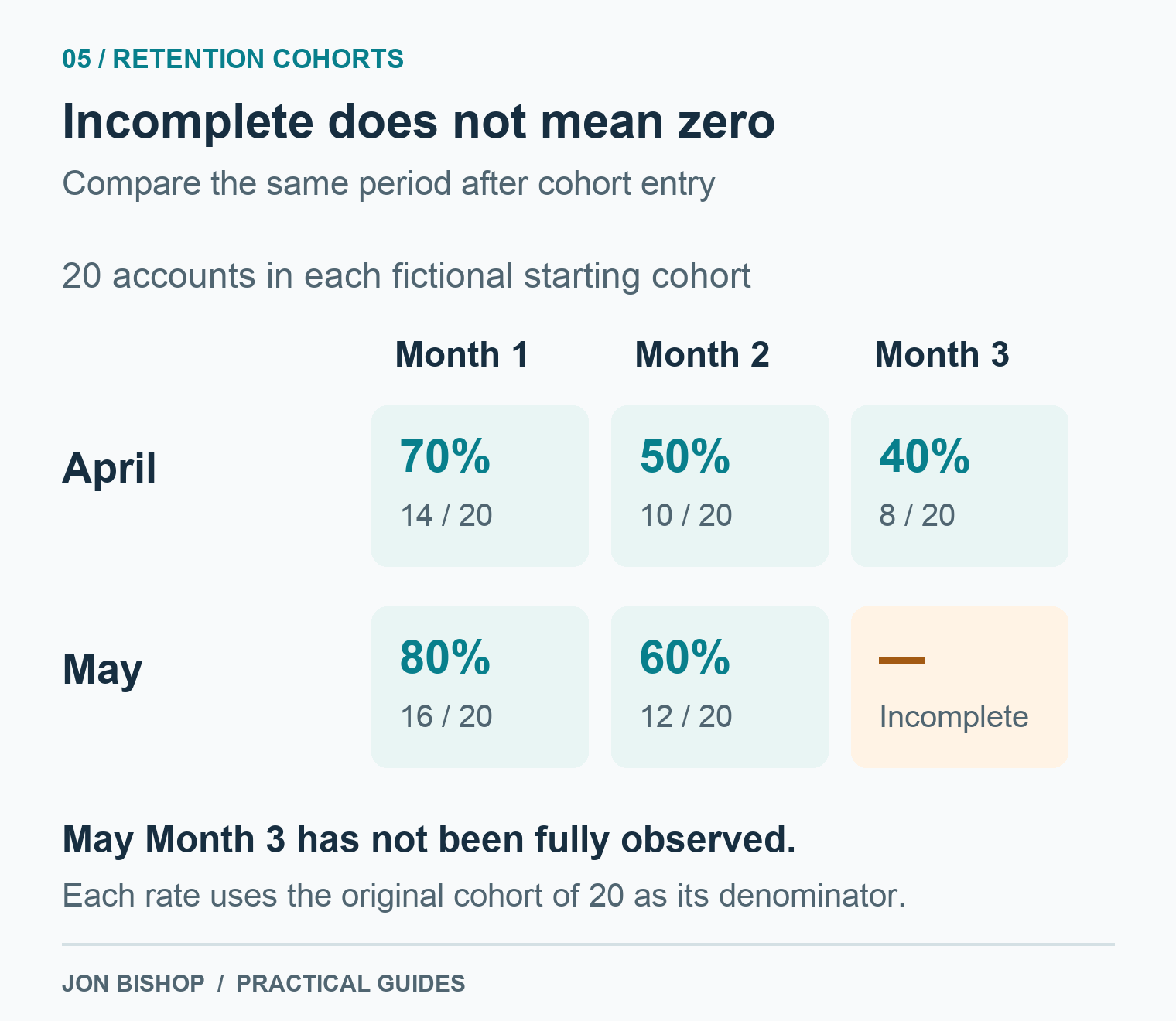
Compare the same observed period. May's incomplete third month cannot support a Month 3 comparison.
May is ten percentage points higher at Month 1 and Month 2 in this example. With only 20 accounts in each group, that difference represents two accounts per period. It suggests a question to investigate, not a conclusive explanation or universal benchmark.
Check the records before interpreting a change
Confirm that the event definition and capture method stayed consistent. Inspect duplicate events, account identity, internal records, merged accounts, and gaps in collection. A missing event can be an instrumentation issue rather than lost value.
Use the measurement plan guide to separate raw events from account-level aggregation. One account completing several reports still counts once in that period's retention numerator.
Check cohort maturity at the report cutoff. Mark newer cells incomplete. Do not fill them with zero or carry an earlier rate forward as if the later outcome had happened.
Investigate plausible explanations
Compare acquisition context, product version, onboarding support, workflows, and requirements. If May received hands-on setup while April did not, that is a relevant difference. It does not prove that assistance caused the observed change.
Look at both returning and inactive accounts. Ask what happened around the task: did the need recur, did setup remain available, did the output help, or did the customer adopt another process? Use customer interviews to understand the episode.
Segment only when a difference could change a decision and the records support the grouping. Tiny subdivisions can produce unstable rates while hiding the individual cases worth examining.
Choose a bounded intervention
If an observed setup problem interrupts repeat work, test its repair. If a segment has no recurring need, reconsider whom you acquire or how the offer is framed. If activity measurement is incomplete, improve collection before judging behavior.
Define the population and observation window for the next comparison. Keep important guardrails, such as output correctness or delivery effort, beside activity rates. More repeated actions are not automatically more customer value.
Use the cancellation learning guide when the question involves a commercial exit. Inactivity, cancellation, and contract expiration are separate outcomes.
Keep the report interpretable
Retain counts, rates, definitions, cutoff date, missing cells, known differences, and the decision. Preserve versions when the definition changes so historical comparisons are not silently rewritten.
Download the retention cohort worksheet to define the measure, compare equivalent periods, and record the next investigation. A useful retention report explains what can be compared and what remains unknown.
For a commercial exit rather than inactivity, continue with learning from cancellations.
Explore the SaaS growth guides and templates to choose another problem to work on.