COURSE READING AND WORKSHEETS
How to find your best-fit SaaS customers
Your best-fit customers get a useful result from the product and can be served sustainably. Compare actual customer experience, commercial value, and delivery effort before deciding whom to acquire more of. Then turn the patterns into a specific audience hypothesis you can test.
Define what best means for the decision
Start with the decision: which customer group should receive more acquisition effort, which offer needs a change, or where should onboarding improve? Different decisions may require different definitions of fit.
Revenue matters, but it is not the whole picture. A large account may require extensive custom work. A smaller account may get consistent value with little assistance. Neither is automatically the better customer; your product strategy and operating capacity affect the choice.
Write the dimensions you will compare: customer result, repeat use when relevant, commercial commitment, delivery effort, and product requirements. Keep them separate before attempting a combined score. A single “fit” number can hide a tradeoff the team needs to discuss.
Choose a comparable population
Decide whether you are comparing paying accounts, trials, or another defined group. Keep those populations distinct. Include customers who stopped or failed to reach value, where records are available, rather than examining only survivors.
Match observation periods. An account with twelve months of history has had more opportunities to use, renew, and request support than one acquired last week. Group customers by tenure or compare equivalent windows after onboarding.
The measurement plan guide helps define units, eligibility, and windows. Record gaps before drawing conclusions: incomplete support logs or changed product events can make accounts appear easier to serve than they were.
For a small customer base, use individual account records and qualitative investigation. You do not need to manufacture statistical precision to notice a workflow worth exploring.
Keep incomplete history out of mature comparisons
A fictional reporting business might classify records this way:
| Account history | What you can assess now | What remains unknown |
|---|---|---|
| Two days since signup | Setup progress and immediate blockers | Completion of a weekly reporting cycle |
| Eight weeks with completed reports | Repeated task completion in that window | Annual renewal behavior |
| Account stopped during setup | Observed obstacle and support effort | Value it might have reached under different conditions |
Do not record “no renewal” for an account that has not reached a renewal date. Keep it incomplete for that measure. Compare like windows, then investigate individual cases that explain the pattern.
Record value to the customer
Identify the job each account uses the product to complete. Look for evidence of the result, not just activity. Frequent logins may indicate value, confusion, or repetitive manual work.
Capture what changed for the customer, how they know, and what remains difficult. Use product records, support context, and direct conversations as appropriate. If you have only an estimated benefit, label it as an estimate.
A fictional reporting product might help agencies prepare a weekly client report. A completed report shows task completion; the agency's account of how it uses that report explains the value. Counting dashboard views alone cannot establish either.
Use customer interviews to investigate why apparently similar accounts have different outcomes.
Compare commercial value and delivery effort
Use revenue in consistent units and periods. Separate recurring revenue from one-time fees, discounts, refunds, and other adjustments that affect the question. Avoid projecting a precise lifetime value from a short history without supported assumptions.
Alongside revenue, record direct operating costs and attributable delivery work where available. Note setup assistance, support, custom implementation, and ongoing service. Estimated hours can still inform a decision if their basis and limits are visible.
A fictional comparison illustrates a tradeoff. Account A pays $400 a month and needs two support hours monthly. Account B pays $900 and needs twelve. At an assumed $50 per support hour, support-adjusted amounts are $300 and $300 respectively. This is revenue - support hours × assumed hourly cost.
Those invented figures do not represent profit or a complete contribution margin. They exclude other costs and ignore strategic differences. They simply show why revenue alone can conceal delivery work.
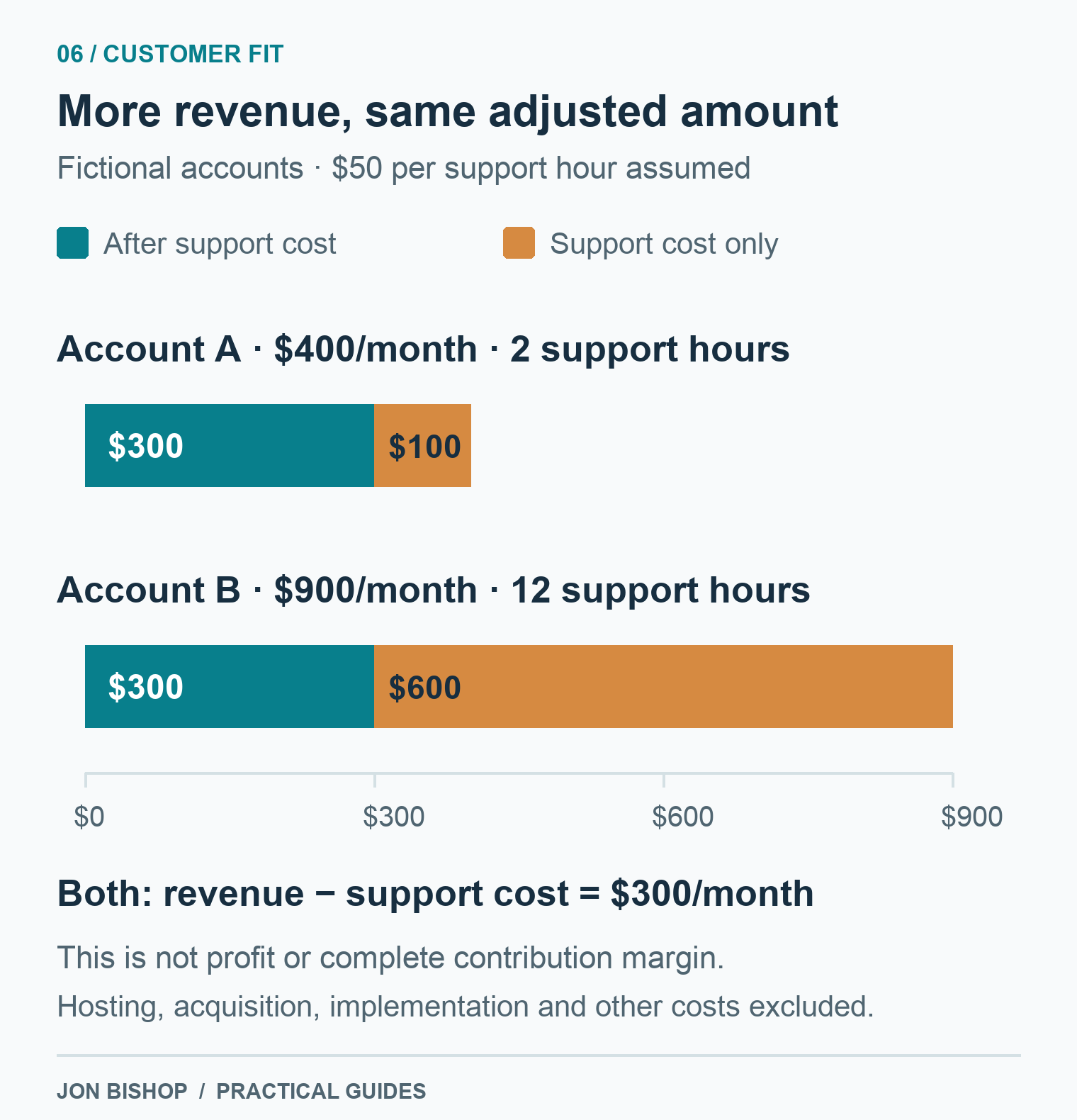
At the same assumed $50 per support hour, the two accounts have equal support-adjusted amounts. Other costs are excluded; this is not profit.
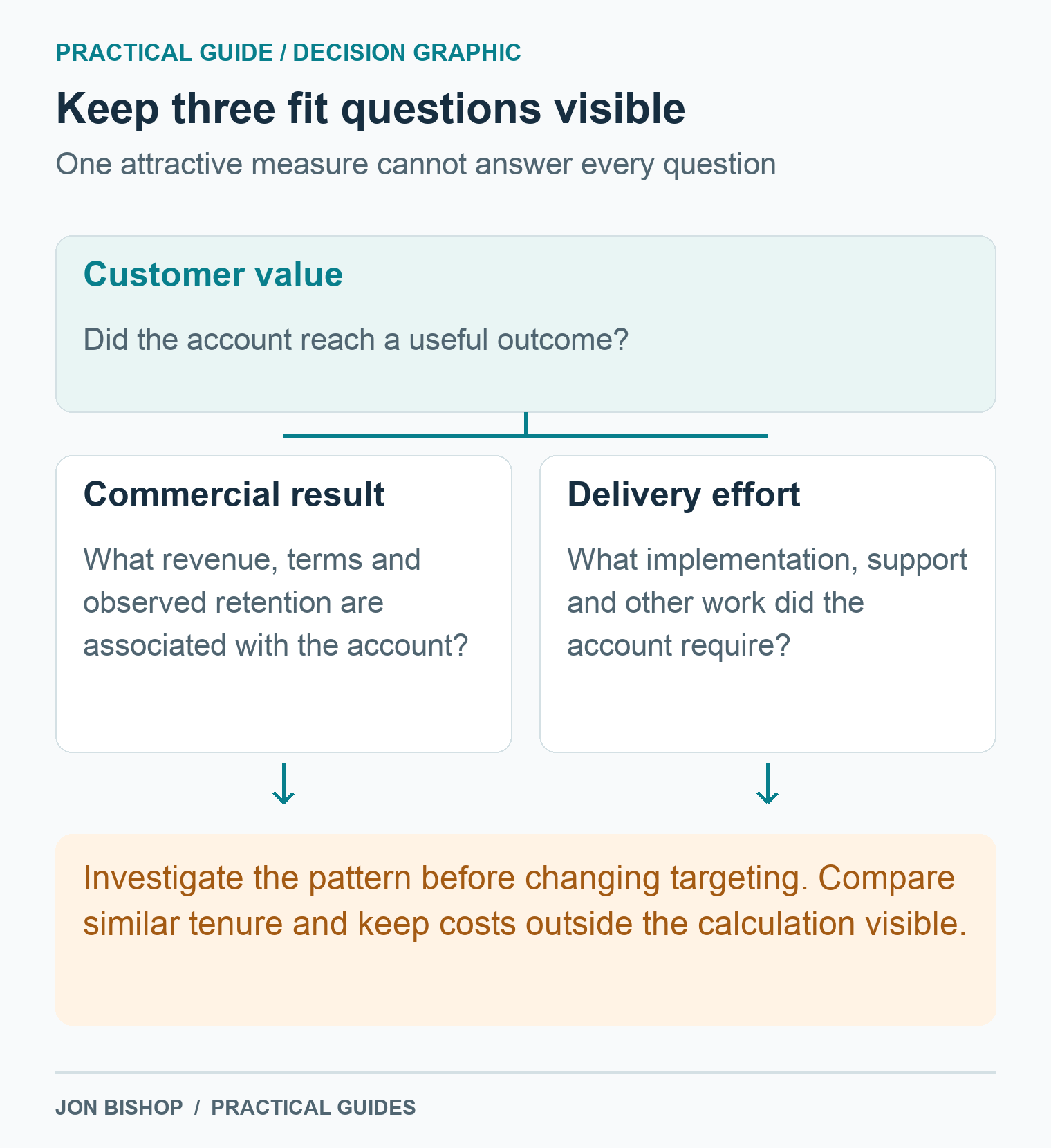
The three views prevent revenue alone from defining fit. Keep differences in tenure, delivery assistance and cost scope visible when comparing accounts.
Look for patterns that could explain fit
Compare workflows, requirements, buying context, and adoption conditions. A common integration or recurring task may explain outcomes better than industry or headcount alone.
For the fictional reporting product, successful accounts might have a predictable weekly reporting task and consistent source data. Less successful accounts might need a different reporting format every time. That is a hypothesis about workflow fit, not proof that a particular company category is better.
Distinguish facts you knew before acquisition from behaviors that happened afterward. A recurring reporting need may help identify prospects. Completing onboarding cannot be used as a pre-acquisition filter unless you define a different, observable proxy.
Record disconfirming cases. If an account outside the proposed segment succeeds, investigate why. A useful segment definition should explain differences rather than simply describe your favorite customers.
Check alternative explanations
A high-performing group may have received more hands-on help, entered through a trusted partner, or joined after a product improvement. Those conditions can affect outcomes independently of customer attributes.
Compare the relevant context before concluding that the segment caused better results. If your records do not allow that distinction, state it. The next step may be a comparable evaluation rather than an immediate budget shift.
Watch for concentration as well. A single large account can dominate a group's revenue or feedback. Show counts and individual exceptions alongside averages. A pattern drawn from two accounts should remain a tentative finding.
Turn a pattern into an audience hypothesis
Write whom you want to reach, the problem they experience, the conditions needed for value, and the evidence behind the choice. Include the uncertainty you still need to resolve.
For example: “We will test whether agencies with a recurring weekly reporting workflow and stable data sources can complete reports with less ongoing assistance.” This fictional hypothesis can guide recruitment and an evaluation without promising a universal result.
Use the audience definition worksheet to document requirements, discovery filters, and disqualifiers. Do not enrich records with unrelated personal information simply to make the segment more detailed.
Test acquisition and onboarding implications
Choose a bounded next action. You could recruit comparable prospects from the proposed group, improve onboarding for a recurring obstacle, or adjust an offer whose service demands are excessive.
Define the result and observation period before the test. Track customer value and delivery effort alongside acquisition outcomes. More signups from a segment do not establish that its members can be served successfully.
Use choosing a marketing channel when the next test concerns reachability. If the fit problem is product compatibility, additional promotion may only bring more unsuitable evaluations.
Keep the definition revisable
Document the account population, period, dimensions, findings, exceptions, and next decision. Review when the product or delivery model changes enough to affect fit. Customers who needed substantial assistance early may require less after an onboarding improvement.
Download the customer-fit analysis worksheet to compare accounts without collapsing every dimension into one score. The useful output is a supported next test, not a permanent label attached to every customer.
Use the finding to revise your audience definition, preserving exceptions and the next hypothesis to test.
Explore the SaaS growth guides and templates to choose another problem to work on.