COURSE READING AND WORKSHEETS
How to get leads at a conference without a booth
To get leads at a conference without a booth, identify relevant people before the event, arrange a few conversations, learn about their problems, and agree on a useful next step. Keep enough notes to follow up on what you discussed.
You can do this as a founder with a ticket and a calendar. The difficult part is choosing an event with the right people and giving them a good reason to talk.
Decide what the event is for
Pick a primary outcome. You might want customer interviews, technical evaluations, partner conversations, or meetings about a product people can buy now.
Those outcomes require different conversations. If you're still validating the problem, don't pretend every interview is a sales opportunity. If you're selling a product, don't count every friendly conversation as a lead.
For this guide, a useful lead means someone who appears to fit your audience, has a relevant problem, and has agreed to a next step worth pursuing. Record uncertainty about their authority, timing, and fit instead of guessing.
Choose the event by who you can meet
Inspect the agenda, speakers, sponsors, participating companies, and available descriptions of attendees. Look for evidence that the people with your problem will be there.
Also check how the event supports conversations. Workshops, small meetups, office hours, and organized networking can give you more context than approaching random people in a large exhibition hall.
Count the full cost: ticket, travel, lodging, preparation, time away from work, and follow-up. A conference that is convenient and relevant can be useful even if it is smaller or less famous.
Don't assume an event will supply a usable attendee list. Use public information and participation features you are allowed to access. Respect organizer rules and people's communication preferences.
Build a small list before you arrive
For each person or company, record:
- Why they may be relevant.
- What you actually know about their problem.
- Whether they have publicly indicated attendance.
- A useful conversation or resource you could offer.
- How to contact them appropriately.
Separate evidence from inference. A company hiring platform engineers may be growing its infrastructure team; that does not prove it needs your monitoring product.
Start with existing relationships and introductions. Then approach a manageable number of people whose work you can discuss specifically.
An invitation for a fictional API monitoring product could be:
> Hi Maya — I saw you're speaking about webhook reliability at the conference. I'm building a tool for investigating failed deliveries, and I'm interested in how teams decide which failures need attention. If you have 15 minutes after your session, I'd enjoy comparing notes. Happy to send my debugging example either way.
The invitation gives a reason to meet without pretending you know their internal problems. Use a real resource if you offer to send one.
Prepare a short introduction and a useful artifact
Explain what you do in terms someone can recognize:
> We help platform teams investigate failed webhook deliveries without stitching together logs from several systems.
Then ask about their work. You don't need to deliver the entire pitch before learning whether the problem exists.
Prepare one artifact that fits the event: a short technical example, a checklist, a one-page explanation, or a specific demo. Make it easy to share later. A QR code can help someone find it, but it doesn't replace a relevant conversation.
Keep your calendar usable. Leave space for sessions, breaks, unexpected conversations, and note-taking. A schedule filled edge to edge makes it harder to listen and follow through.
Ask questions that reveal fit
Useful questions include:
- How are you handling this today?
- What tends to go wrong?
- What happens when it does?
- Who else gets involved in fixing or evaluating it?
- Is this something you're trying to improve now, or just exploring?
Listen for a specific situation. “We care about reliability” is different from “We spent yesterday matching failed deliveries to customer tickets.”
If there's a fit, ask permission before moving into a demo or sales discussion:
> That sounds close to the workflow we're working on. Would a short example be useful, or would you rather I send it after the event?
If there isn't a fit, finish the conversation warmly. A relevant introduction or a useful exchange can still be valuable without becoming pipeline.
Agree on the next step
“Let's keep in touch” gives neither person much to act on. Make the next step concrete:
- Send the example you discussed.
- Introduce someone to a relevant colleague.
- Arrange a technical evaluation call.
- Review a particular workflow together.
Confirm the contact route and who should be involved. If someone gives you an address for a requested follow-up, don't assume they also want an unrelated newsletter or automated sequence.
Decide what kind of follow-up the conversation earned
Use the actual agreement to choose the next action. In these fictional cases, each person leaves the event with a different kind of record:
| Conversation | What is known | Appropriate follow-up |
|---|---|---|
| A developer asks for the debugging example | Interest in the resource; product need is unknown | Send the example, without calling it a sales opportunity |
| A team lead describes the problem and agrees to assess compatibility | Relevant workflow and an agreed question | Arrange a discovery conversation around that question |
| A friendly attendee says the product sounds interesting | Positive reaction; no next action agreed | Record the conversation without inventing a meeting commitment |
Before ending, confirm the promised resource or question and the preferred contact route. A useful note lets you fulfill an agreement; a contact record alone does not.
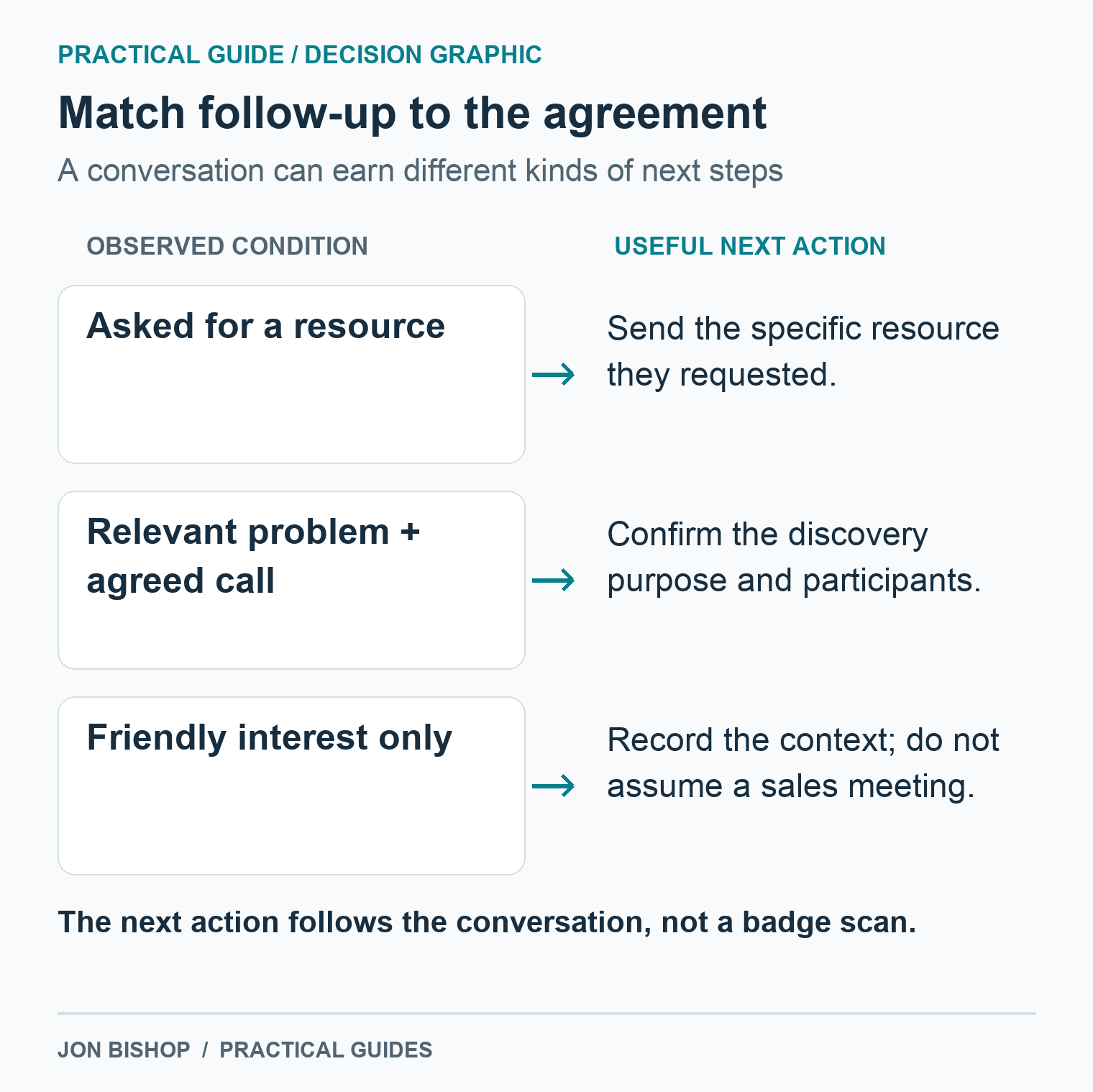
Record what was agreed and respect its scope. These routes distinguish permission to send a resource from agreement to continue a commercial conversation.
Keep notes while the conversation is fresh
Use a simple log:
| Field | What to record |
|---|---|
| Person and company | Name, role, company, appropriate contact route |
| Fit | Which audience criteria seem to match; what remains unknown |
| Problem | Their description of the workflow and difficulty |
| Context | Session, introduction, or conversation that brought you together |
| Next step | What you agreed to do, who owns it, and when |
| Status | Resource sent, meeting arranged, evaluation started, no current fit |
Avoid storing unnecessary personal details. Your notes should help you keep a promise and understand business relevance.
Follow up with the actual conversation
Send the promised material while it is still relevant. For example:
> Hi Maya — good talking after the webhook session. You mentioned the difficulty of connecting failed deliveries to support tickets. Here's the debugging example I promised. The section on matching delivery IDs to ticket context is the part we discussed. If you'd like, we can walk through how your team handles that step and see whether our tool could help.
If you agreed on a date or meeting, include it. If they were only interested in the resource, send the resource without inventing stronger buying intent.
A later follow-up should add a relevant reason to reply. Repeating a generic reminder several times rarely improves the substance of the offer.
Evaluate the event by what happened afterward
Track relevant conversations, agreed next steps, completed meetings, evaluations, and eventually customers. Keep counts distinct so a pile of contacts doesn't become a pile of “qualified leads” by relabeling it.
For a fictional event costing $1,500 in direct expenses, five completed qualified meetings means $300 in direct event cost per meeting. That calculation excludes preparation and follow-up time, and it does not establish customer acquisition cost. You need actual customers and appropriate cost allocation to calculate that.
Separate new opportunities from progress on existing deals. An event may help a deal move forward without having created it, and some conversations may produce value much later.
Your first event should leave you with both useful relationships and a clearer understanding of whether this particular event reaches your buyers. Use that evidence to improve the next decision.
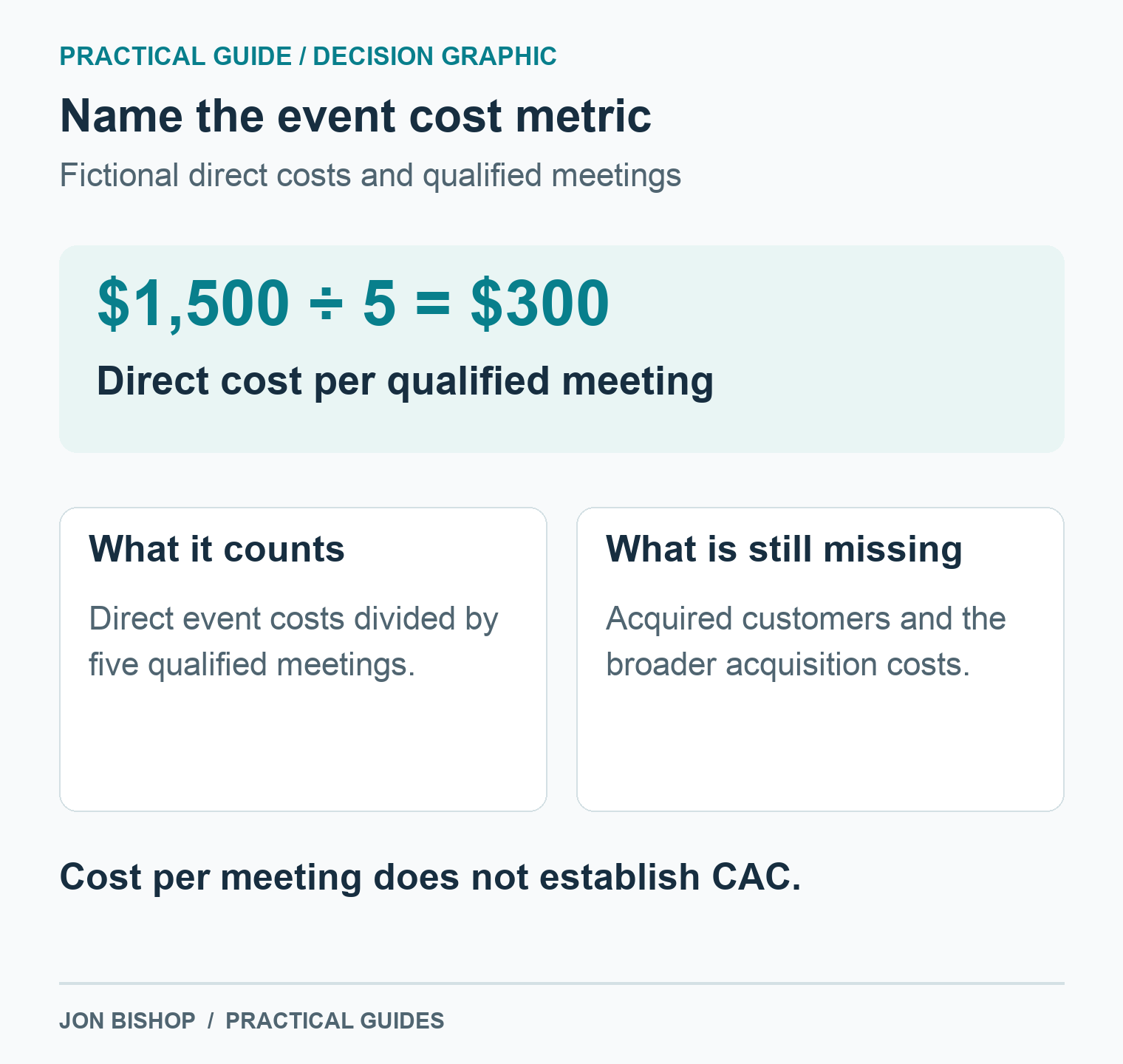
The calculation describes direct cost per qualified meeting. It cannot establish customer acquisition cost without acquired customers and a defined acquisition-cost scope.
Use the meeting and follow-up template
Download the conference meetings and follow-up kit. It includes an event brief, target and conversation logs, questions, messages, and an event review.
Decide whether events fit your plan
Use the channel selection guide to compare an event with other ways to reach your audience. All messages and calculations in this guide are fictional examples. The distinction between attending, hosting, sponsoring, and speaking is also covered in Corey Haines's events skill.
Explore the SaaS growth guides and templates to choose another problem to work on.