COURSE READING AND WORKSHEETS
How to plan a SaaS product launch
A SaaS launch needs more than an announcement date. Define whom the release is for, what those people should do next, and how they will reach a useful result. Then coordinate the product, message, distribution, measurement, and support around that path.
Give the launch one primary objective
Decide what this launch should accomplish. An early product might need qualified evaluations. An established product might need existing customers to adopt a capability. A public announcement might help explain a new category or reposition the offer.
Choose an objective that matches the product's readiness and the evidence you need. “Awareness, signups, revenue, and market leadership” makes it difficult to prioritize tradeoffs. You can monitor secondary outcomes without treating every measure as the primary goal.
Define the audience and the next action together. “Invite engineering teams with recurring API test failures to evaluate a supported integration” is more actionable than “Reach developers.” The audience guide helps make that choice specific.
Map the path from announcement to value
Write the steps someone must take after encountering the launch. For a fictional monitoring product, the path might be: read the relevant explanation, check compatibility, start an evaluation, connect the test environment, investigate a failure, and decide whether to continue.
Ask what each step requires from the customer. A launch that promises an immediate result but needs a long procurement process has a mismatch between message and experience. A limited evaluation can be a valid next action if its scope is clear.
Show the result in your demonstration. Explain what the product needs as input, what it produces, and what the customer can do with that output. Avoid using a polished demo to imply that unsupported environments or unfinished capabilities are available.
Agree on readiness and limits
Set launch criteria before the team becomes attached to a date. Criteria should cover the promised workflow, the offer, support capacity, measurement, and any dependencies needed for the intended audience.
Useful questions include:
- Can a suitable customer complete the promised workflow?
- Are compatibility requirements and limitations clear?
- Does the signup, evaluation, or purchase path work?
- Are price and evaluation terms understandable where relevant?
- Can the team answer questions and resolve likely setup problems?
- Is someone responsible for deciding whether to delay or narrow the release?
A smaller launch can be appropriate when you can support a limited group but are not ready for a broad release. Specify the capacity and admission criteria instead of creating artificial scarcity. If a critical readiness condition fails, change the date, scope, or promise.
Make the readiness decision explicit
A launch checklist is useful only if a failed check changes the release. In this fictional evaluation launch, the team could use these rules:
| Check | Evidence | Action if it fails |
|---|---|---|
| A suitable account can complete setup | End-to-end test in the supported environment | Repair setup before inviting evaluations |
| Assisted evaluations fit team capacity | Named owners and available support hours | Reduce the invited group to the supported capacity |
| The next-action path works | Form, confirmation, and owner receipt checked | Repair the path before distribution |
| A partner will participate | Confirmed scope and timing | Remove the partner from the volume model and reassess the goal |
Assign one person to make the final scope/date decision. A partner cancellation need not delay a technically ready release, but it should change a plan that depended on that partner's audience.
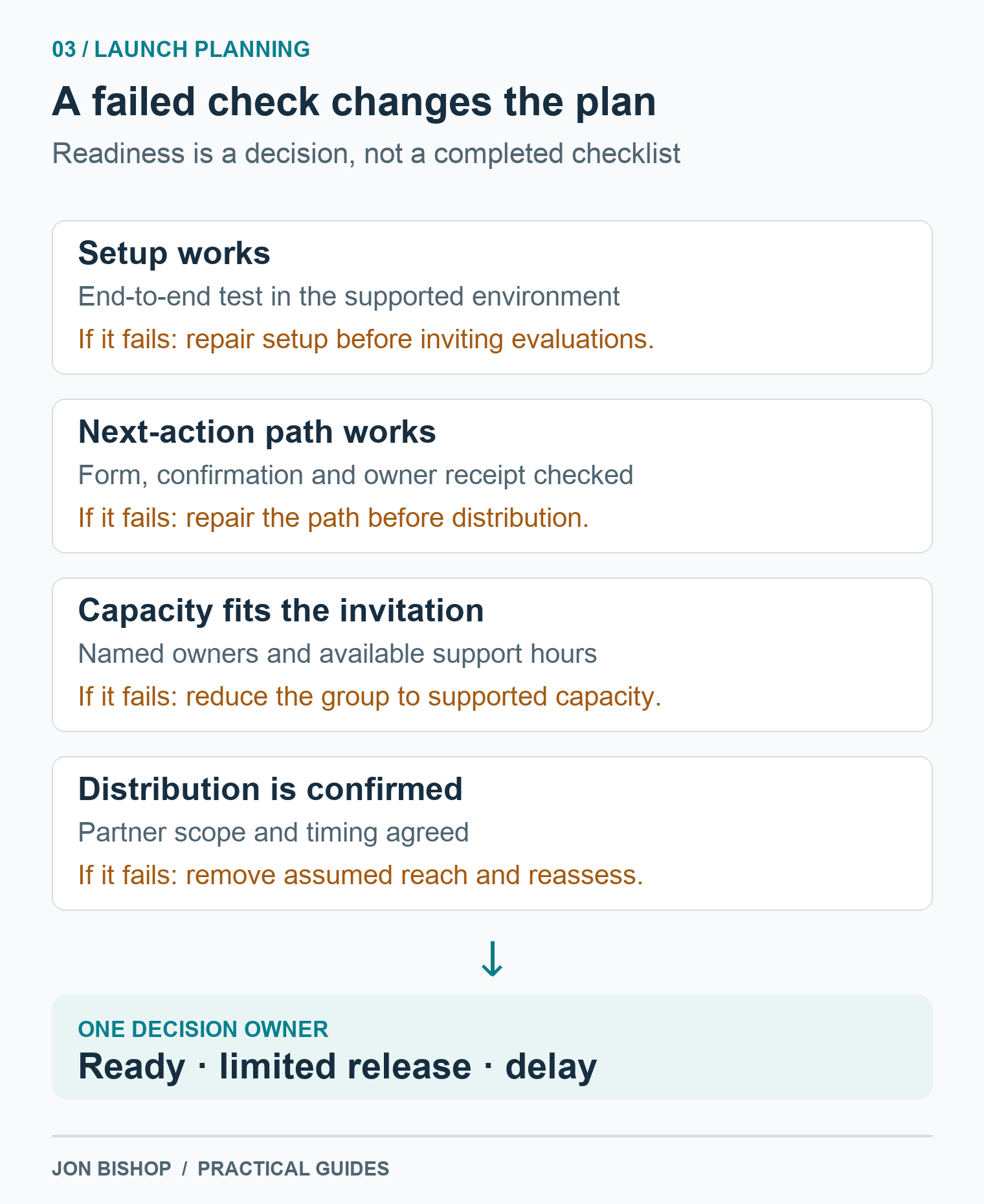
Each failed readiness check changes a specific part of the plan. The final decision belongs to one named owner.
Build the minimum asset set
Each asset should help a person understand the offer or take the next step. Start with a launch page, a usable demonstration, a clear next-action path, onboarding guidance, and answers to the questions most likely to block an evaluation.
Adapt the message to each channel while keeping the promise consistent. An email to an existing customer can assume more context than a public announcement. A partner needs enough information to assess relevance to their audience. Neither needs every feature listed.
Give each asset one owner, a reviewer if needed, and a dependency. For example, screenshots depend on stable product behavior; onboarding instructions depend on the actual setup path. Work backward from those dependencies when planning review dates.
Separate required assets from optional ideas. Additional videos, guest posts, or elaborate launch-day graphics should not consume the time needed to make the evaluation work.
Choose distribution you can execute
Select a small number of routes where you can explain why the audience is present and why the announcement is relevant. Existing customer communication, a partner relationship, or a community where you already participate may be more feasible than starting several unfamiliar channels at once.
For each route, state the intended audience, message, next action, owner, cost, and expected feedback. Verify any platform or community submission rules before scheduling. Do not assume access to someone else's mailing list or permission to post promotional material.
Keep requests to partners concrete: what you are asking them to share, why their audience may care, what is ready to review, and when a response is useful. A potential partner is a dependency until they confirm participation.
Use choosing a SaaS marketing channel when a route needs its own bounded test. Launch urgency does not make an untested channel predictable.
Model volume as an assumption
A simple model helps expose whether a goal depends on traffic, conversion, or capacity. It does not turn guesses into a forecast.
Suppose a fictional launch aims for 20 completed evaluations. If you assume 25% of qualified signups complete an evaluation, you need 80 qualified signups. If you assume 4% of relevant visitors become qualified signups, you need 2,000 relevant visitors: 20 / 0.25 / 0.04 = 2,000.
These numbers are invented planning assumptions, not benchmarks. Change them using comparable evidence when available. Model weaker and stronger scenarios, and record where each assumption comes from. Avoid combining traffic from audiences with very different relevance under one unexplained conversion rate.
Check delivery capacity alongside volume. If each evaluation requires two hours of support, 20 evaluations imply 40 hours of that work under the fictional assumption. If the team cannot provide it, revise the onboarding, scope, or goal before increasing promotion.
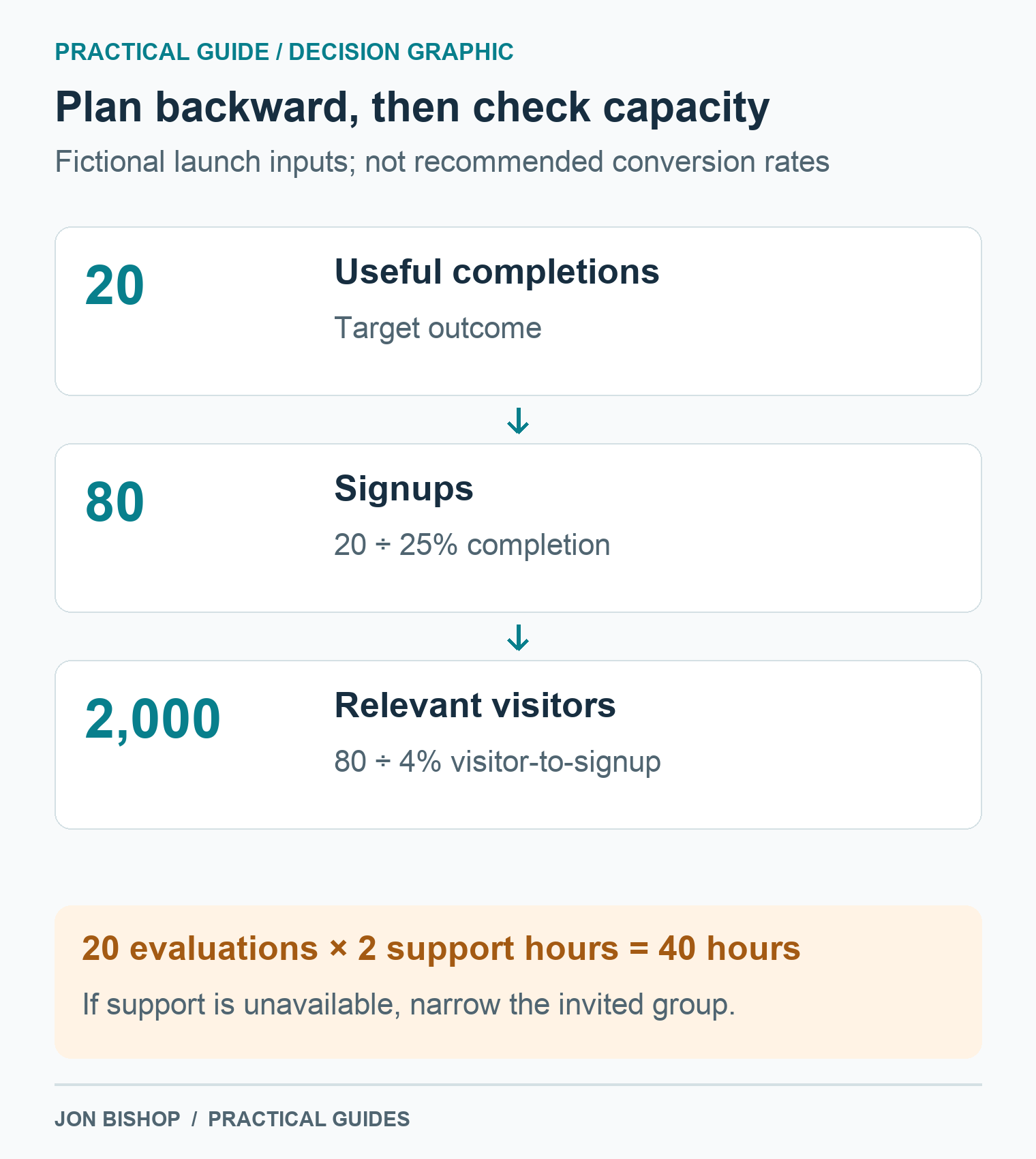
These fictional rates are planning assumptions, not a forecast. The support estimate applies when all twenty evaluations require the assumed two hours of help; check capacity before distribution.
Use a schedule with decision gates
Work backward from the release using milestones rather than a list of launch-day posts. First agree on the audience, objective, promise, and evaluation path. Then complete the product and asset dependencies, test the experience, confirm distribution, and make the readiness decision.
Assign a decision owner to each gate. A review should end with a clear outcome: ready, ready with a stated limit, or blocked by a specific issue. Do not let “almost finished” silently become approval.
Keep a contingency for the most important dependencies. If a partner cannot participate, decide whether the remaining distribution supports the objective. If onboarding fails, narrowing the audience or delaying may be more useful than publishing more announcements.
The companion template uses relative milestones, so you can set dates appropriate to your team rather than adopt an arbitrary universal launch timeline.
Prepare for the day after the announcement
Decide who watches the evaluation queue, who handles support, and who updates unclear instructions. Record recurring questions and the point at which people encounter them. Those notes can reveal a message problem or a product obstacle.
Review results after the agreed observation window. Compare the audience reached, next actions, completed evaluations, customer results, and support effort with your assumptions. Distinguish a channel that reached the wrong people from a product that failed to help suitable people.
Launch traffic alone does not establish product-market fit. Signups alone do not show that users reached value. Use the measurement plan guide to define the events and denominators before judging the outcome.
Keep the learning and decide what happens next
Close the launch with a decision: continue a promising distribution route, improve the evaluation, narrow the audience, fix a readiness issue, or run a different test. Give that decision an owner and a review date.
Download the SaaS launch planning workbook for the objective, readiness gates, asset owners, volume assumptions, and review. A useful launch leaves the team with evidence for the next move as well as an announcement to point to.
Explore the SaaS growth guides and templates to choose another problem to work on.