COURSE READING AND WORKSHEETS
How to hire a marketing contractor for your SaaS
Hire a marketing contractor by defining the problem you need help with, matching it to relevant experience, and agreeing on a small paid project with clear deliverables. Review both the work and how the person works with you before expanding the engagement.
“We need more growth” is a difficult job to scope. “We need someone to turn our customer interviews into homepage messaging and a campaign brief” gives you something concrete to evaluate.
A contractor can add expertise or capacity without becoming a full-time hire. You still need to provide context, make decisions, and give the person access to the resources needed to do the job.
Define the job before looking for a person
Start with the bottleneck. Are you unsure who to target? Are qualified buyers reaching the website but failing to understand the product? Have you found a promising channel but run out of time to execute it?
These situations call for different work:
| Situation | Help to look for | A useful initial deliverable |
|---|---|---|
| Audience and positioning are uncertain | Customer research and product marketing | Evidence synthesis and a proposed audience or positioning decision |
| A channel seems promising but execution is inconsistent | A specialist in that approach | Campaign plan, required assets, measurement and a limited pilot |
| Buyers misunderstand the product | Messaging and website copy | Customer-informed copy brief and a page draft |
| You cannot trust the reports | Analytics implementation and analysis | Tracking audit, definition fixes and a validated report |
| You need to decide what to prioritize | An experienced strategist with early-stage judgment | Prioritized plan with assumptions, tradeoffs and ownership |
The important difference is between discovering an approach and scaling one. Someone who has managed a successful channel at a mature company may have little experience building it from scratch. Someone who enjoys ambiguous research may be a poor fit for ongoing production work.
You do not need every part of the business solved before bringing in help. You do need a mandate that matches the uncertainty. A research engagement can help you learn about demand; it should not be evaluated as though you already have a proven acquisition engine.
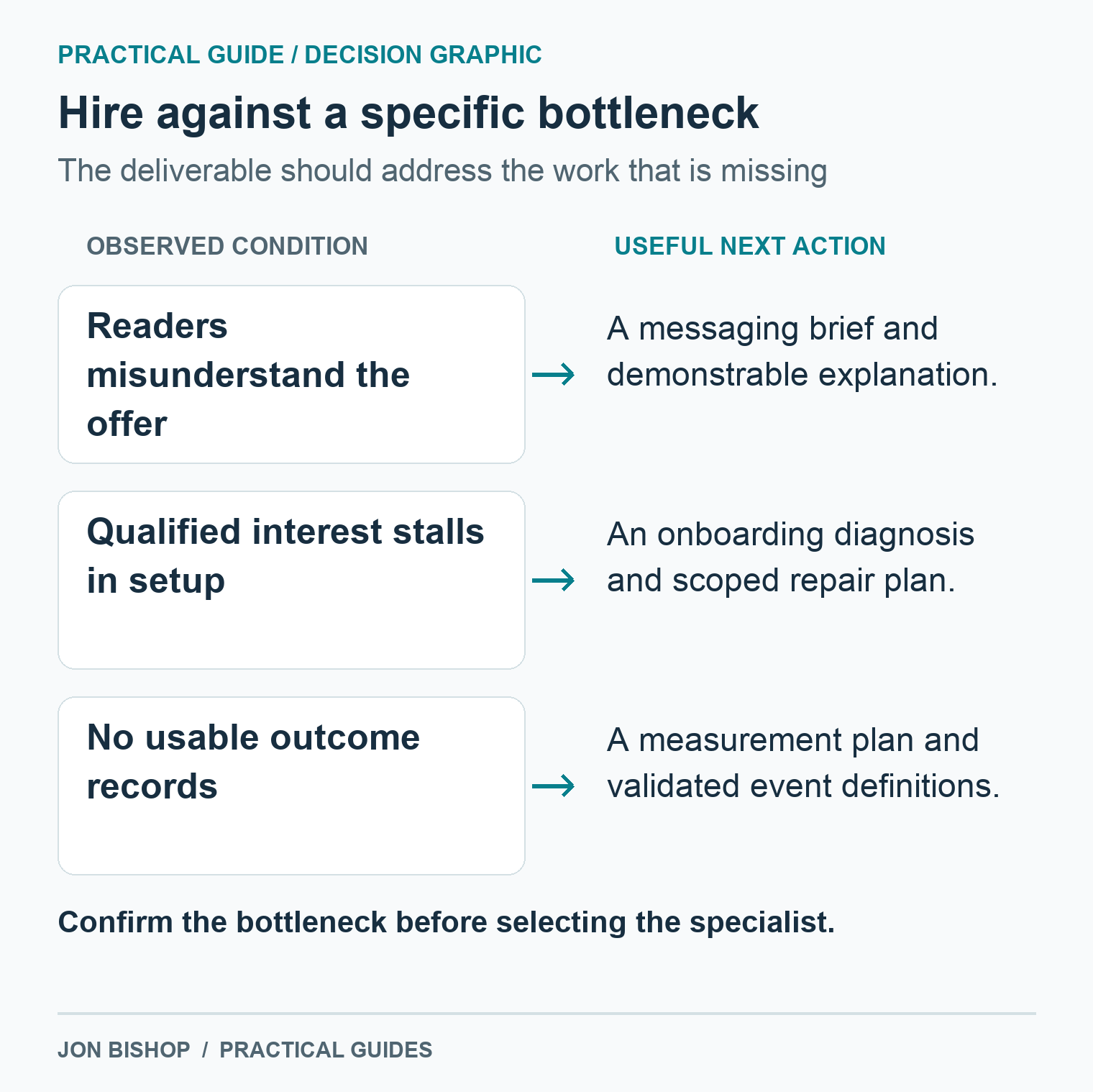
These are scope examples, not diagnoses of your business. Confirm the problem and required skills before choosing a contractor or deliverable.
Write a short role brief
Describe the product, audience, stage, problem, desired output, and constraints. Specify what you can supply and what the contractor must investigate.
Include an available budget or ask for a scoped proposal against a clear brief. Contractor fees and campaign spending are separate. A person hired to run paid acquisition needs to know what resources exist for media, creative, implementation and analysis.
Make ownership explicit. Who approves copy? Who can change the website? Who answers product questions? Who handles customer conversations? Which tasks depend on engineering?
A fictional brief might say:
> We sell an API monitoring tool to small platform teams. Our homepage describes features but does not explain the investigation workflow clearly. We have six customer interview summaries and a working product demo. We want a contractor to synthesize those inputs, propose a messaging hierarchy, and draft homepage copy. The founder approves positioning; an engineer implements the page. This project does not include a redesign or paid campaigns.
That scope makes it easier for a good candidate to explain their approach and estimate the work.
Find people with relevant evidence
Look through trusted recommendations, professional profiles, specialist communities, and portfolios. A referral is a starting point for evaluation, not a substitute for it.
Ask for examples that match the work you need. For a technical product, inspect whether the candidate can explain an unfamiliar workflow accurately. For channel work, ask how they chose the audience and offer, what they implemented, and what happened afterward.
A recognizable company name tells you little about the person's actual contribution. Find out what they owned, what support they had, and whether they arrived before or after the approach was working.
Review experience across these dimensions:
- The task: research, strategy, production, implementation or optimization.
- The stage: little evidence, initial traction or established demand.
- The audience and buying process.
- Available budget, team and distribution assets.
- The person's actual responsibility for the work.
A close match on the task and constraints can matter more than an exact match on industry.
Interview around the work
Give the candidate your brief and ask them to explain how they would approach it. Useful questions include:
- What would you need to learn before making a recommendation?
- Which part of this brief would you challenge?
- What have you done in a similar situation, and what did you personally own?
- What would the first deliverable contain?
- What needs to come from us for you to succeed?
- How would we tell whether the work is useful?
- What would make you change direction?
- How do you use AI, and how do you check its output?
Listen for specific questions and acknowledged limits. Someone who offers a confident plan before understanding the audience, product, and resources may be filling gaps with assumptions.
Ask how they communicate a problem or delay. A contractor should be able to explain what is blocked, what they have tried, and what decision they need from you.
For reported results, ask about the time window, baseline, contribution from other work, and access to evidence they are permitted to share. Confidentiality can limit what a candidate shows; it does not require you to accept unexplained performance claims.
Use a small paid project
Choose a project that produces useful work while exposing the skills you need. Agree on payment, scope, access, deliverables, timing, review points and acceptance criteria before starting. Record ownership and usage rights in the engagement agreement.
For the fictional messaging project, a paid trial could produce:
- A summary of patterns from the supplied interviews, with evidence references.
- A proposed messaging hierarchy and the assumptions behind it.
- One homepage hero and one workflow section.
- A short explanation of what still needs verification.
That is more informative than asking for a generic marketing plan or unpaid work you intend to use. Keep the project small enough to assess without turning it into a hidden full engagement.
Avoid judging a short trial solely by revenue. A copy brief cannot establish long-term acquisition performance in a few days. Evaluate whether it is accurate, useful, clear, and ready for the next step. Later campaigns can be evaluated against the outcomes and observation windows they were designed to influence.
Define acceptance before the trial starts
For the fictional messaging trial, acceptance could require that every factual claim has a source, a product reviewer can confirm the workflow, and the hero plus workflow section answer the agreed reader questions. List missing proof explicitly rather than quietly replacing it with stronger copy.
Distinguish corrections from new scope. Fixing an inaccurate description belongs in the review of the agreed deliverable. Adding a pricing page or a second campaign does not. Decide how many review rounds and which reviewer are included before work begins.
A useful trial ends with one of three decisions: proceed with the next scope, request a specific correction within the agreed trial, or decline further work. Do not keep extending the exercise without a new agreement.
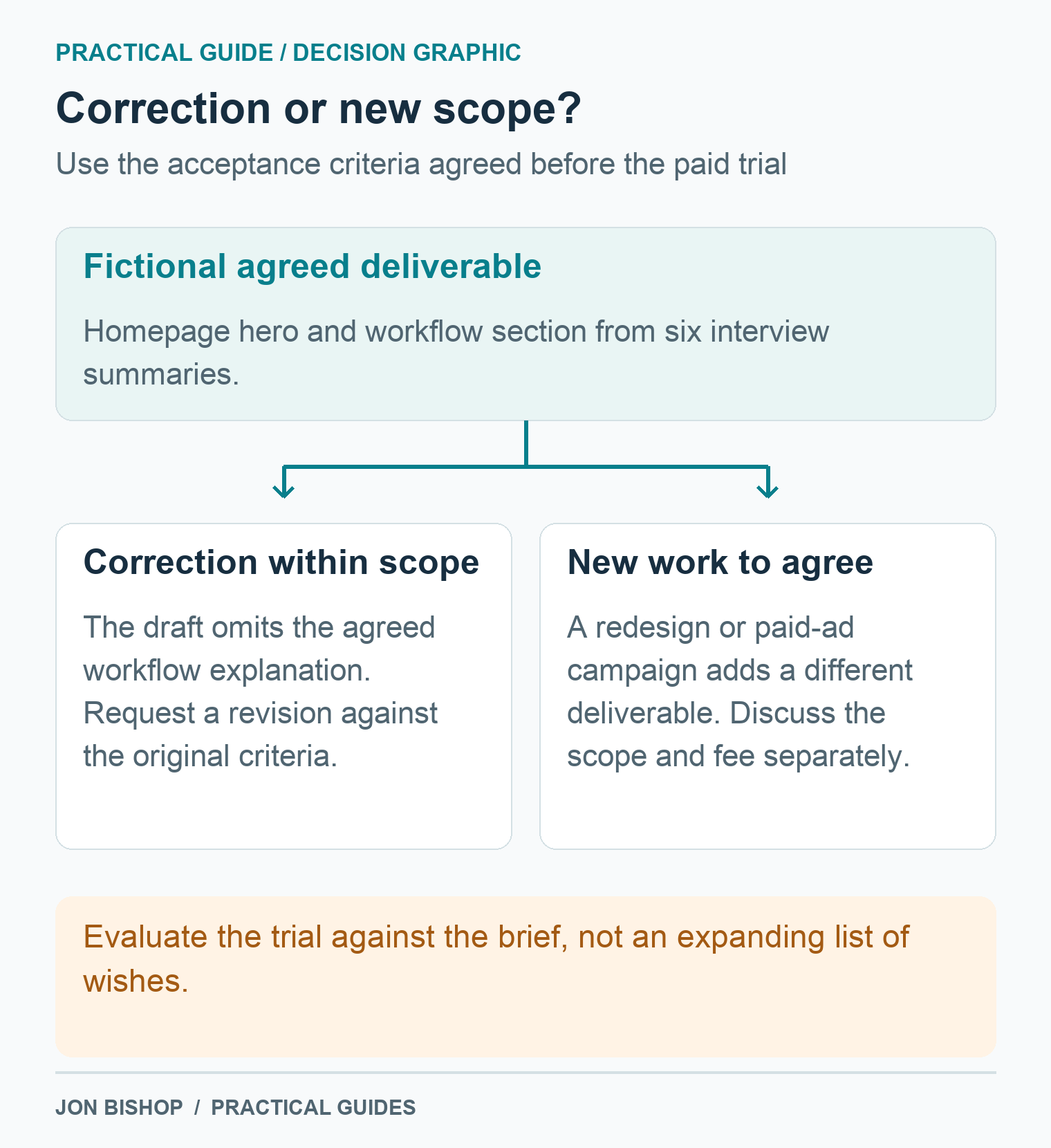
The fictional messaging assignment gives both sides a stable basis for review. Missing agreed work and additional requested work need different responses.
Evaluate the result consistently
Use criteria connected to the job:
| Criterion | What to inspect |
|---|---|
| Understanding | Does the work reflect the product, audience and buying situation? |
| Evidence | Can you trace important claims to supplied or verified sources? |
| Judgment | Are priorities, assumptions and tradeoffs explicit? |
| Execution | Is the deliverable usable and complete within the agreed scope? |
| Communication | Were questions, progress and blockers communicated clearly? |
| Collaboration | Did the person respond constructively to feedback and preserve ownership boundaries? |
Score each criterion using evidence from the trial, not a general impression. Decide your weighting before seeing the result. A researcher and a campaign implementer should not be evaluated with identical weights.
Do not average away a critical failure. Invented customer evidence or inaccurate technical claims need resolution even if the writing looks polished.
Set up the ongoing working relationship
If the trial goes well, agree on the next scope and a review cadence. Keep a shared brief with current priorities, deliverables, dependencies, owners and decisions.
Give feedback at the right level. If the audience or offer is wrong, fix that before debating individual words. If the strategy is agreed, avoid reopening it every time a draft arrives.
Separate activity, deliverables and outcomes in reporting. Publishing four articles is an activity/output; relevant readers completing a useful next step is an outcome. Both matter, but they answer different questions.
When work disappoints, inspect whether the problem is skill, unclear scope, missing resources, changing assumptions, or lack of fit. Use that diagnosis to revise the engagement or end it according to the agreed terms.
Use the role brief and evaluation template
Download the contractor hiring template. It includes a blank role brief, interview questions, a paid-project scope, and an evidence-based scorecard with a completed fictional example.
Continue with your marketing plan
If you need to define the acquisition job before hiring, read How to choose a marketing channel for your SaaS. If the job concerns conversion, use the funnel analysis guide to clarify the problem first.
Explore the SaaS growth guides and templates to choose another problem to work on.